For years, the wearable technology industry has been obsessed with the wrist. Apple Watch measures heart rate, Fitbit counts steps, Garmin monitors exercise, while Oura moved many of those sensors onto the finger and helped popularize concepts such as readiness and recovery. The fundamental idea, however, remained largely the same: collect signals from the body and use algorithms to estimate what is happening inside it.
Muse is putting the sensors somewhere different—on your head. Its headbands use electroencephalography, better known as EEG, to measure electrical activity generated by the brain. Muse cannot read your thoughts, but the technology represents an interesting transition for consumer wearables. After spending years quantifying the body, technology companies are beginning to explore whether we can meaningfully quantify the brain.
What Muse Actually Measures
EEG isn't new. Hospitals and neuroscience laboratories have used electroencephalography for decades, typically placing multiple electrodes around the scalp to measure electrical activity generated by populations of neurons. Muse takes a simplified version of that technology and packages it inside a consumer headband.
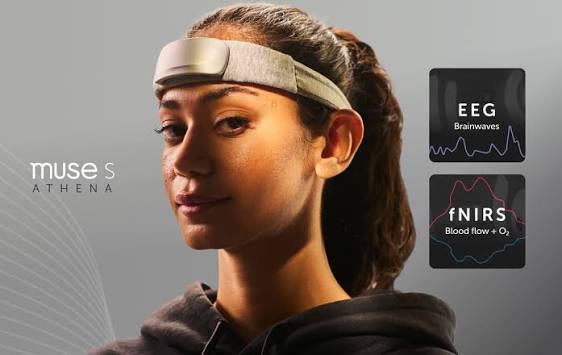
Muse devices use EEG sensors alongside other measurements such as movement and heart activity. The more advanced Muse S Athena also incorporates functional near-infrared spectroscopy, or fNIRS, which uses light to measure changes in blood oxygenation associated with activity in parts of the brain.
The distinction from most conventional wearables is important. A smartwatch can use heart rate, movement and other signals to infer whether you're asleep or stressed. Muse can collect electrical signals directly from the scalp and then use software to interpret patterns within them.
That doesn't mean it knows what you're thinking. EEG doesn't produce a transcript of someone's thoughts. What it can reveal are patterns associated with different physiological and cognitive states, and Muse attempts to turn those patterns into information ordinary consumers can understand.
It Started With Meditation
Muse originally became known primarily as a meditation device. During a session, the headband monitors EEG activity and provides neurofeedback designed to help users recognize when their attention has wandered.
Instead of simply playing a guided meditation and hoping you're concentrating, Muse attempts to respond to what your brain is doing. Its soundscape can change as the detected activity changes, creating a feedback loop between the brain, the device and the person wearing it.
This concept is known as neurofeedback, and it is what separates Muse from a conventional meditation app. An app can tell you to focus on your breathing; Muse attempts to provide information about what is happening while you try to do it.
Whether that feedback produces meaningful long-term improvements is a more complicated scientific question. Consumer neurofeedback research remains an evolving field, with promising findings alongside studies that highlight limitations in methodology and evidence.
Sleep May Be the More Interesting Use
Muse becomes particularly interesting when it is used during sleep. Most consumer wearables estimate sleep stages using combinations of movement, heart rate and other physiological signals. EEG provides another source of information because changes in electrical brain activity are central to how sleep stages are identified in professional sleep studies.
That doesn't make Muse equivalent to a hospital sleep laboratory. Clinical polysomnography uses considerably more equipment and measures multiple physiological signals simultaneously. But putting EEG into a device people can comfortably use at home potentially provides information that wrist-based wearables cannot collect directly.
Muse has also moved beyond simply measuring sleep. Features such as Deep Sleep Boost attempt to use real-time EEG measurements to determine when carefully timed audio cues should be delivered during slow-wave sleep. Smart Wakeup similarly uses the detected sleep state to try to wake the wearer during lighter sleep rather than relying entirely on a fixed alarm time.
The progression is significant. Early wearables measured us, newer devices began interpreting those measurements, and products such as Muse are experimenting with systems that can measure a physiological state and respond to it in real time.
AI Makes the Brain Data More Useful
The next problem is interpretation. Giving someone an EEG chart isn't particularly useful if they don't understand neuroscience, just as showing someone thousands of raw heart-rate measurements isn't necessarily useful without explaining what they mean.
Muse's AI coaching efforts attempt to solve this problem by translating collected information into explanations and recommendations around areas such as sleep, meditation, focus and recovery. Instead of requiring users to interpret neurological and physiological data themselves, AI becomes the layer between the sensors and the person wearing them.
That model could become increasingly common across health technology. Sensors collect increasingly sophisticated biological signals, algorithms identify patterns, and an AI system attempts to explain those patterns in ordinary language while considering a person's historical data.
This may ultimately matter more than adding another sensor. Consumers don't necessarily need more graphs; they need technology capable of explaining whether the information on those graphs should change what they do tomorrow.
Muse S Athena Goes Further
Muse S Athena pushes the idea beyond EEG by combining it with fNIRS. While EEG measures electrical activity, fNIRS looks at changes in blood oxygenation associated with neural activity. Combining the two gives the device different ways of observing what is happening around the brain.
Technology like this was once associated primarily with laboratories, universities and medical environments. Miniaturization is gradually bringing simplified versions into consumer devices that can be worn while sitting at home.
That is an impressive technological development, but it also creates a temptation to overstate what the data means. Measuring a signal from the brain and understanding a person's mind are very different things.
Muse Does Not Read Your Thoughts
This distinction may become increasingly important as brain-sensing consumer technology becomes more sophisticated. EEG measures electrical activity; it does not reveal a person's internal monologue, memories or secret thoughts.
There also isn't a simple electrical signature for concepts such as intelligence, happiness or productivity. Human cognition involves extraordinarily complicated interactions between different parts of the brain, and measurements collected from a handful of electrodes on the scalp provide only a limited view.
Muse should therefore be understood as a sophisticated wellness and neurofeedback device rather than a machine capable of decoding the human mind. The company itself positions its products around wellness rather than medical diagnosis.
That distinction becomes especially important when AI enters the equation. An AI-generated explanation can sound remarkably confident even when the underlying biological signal is ambiguous. Better language does not automatically mean better neuroscience.
Brain Data Raises a Different Privacy Question
There is also a longer-term issue that extends far beyond Muse itself: what happens when brain-related data becomes another ordinary category of consumer information?
People already allow technology companies to collect extraordinary amounts of physiological data. Smartwatches know when we exercise, rings estimate when we sleep, phones know where we travel and health apps can contain years of intimate information.
EEG introduces another category.
Today's consumer headbands cannot extract someone's private thoughts. But neuroscience, sensors and machine learning will continue improving, which means the information that can potentially be inferred from neurological data may become more sophisticated over time.
That raises questions the wearable industry has barely begun confronting. Who owns brain data? How long should companies retain it? Should it be used to train AI models? Could employers or insurers ever request access to cognitive measurements? Should neurological information receive stronger legal protection than ordinary fitness data?
Those questions may sound premature when discussing a meditation headband. They will sound considerably less premature if brain-sensing wearables become as common as smartwatches.
The Next Wearable May Not Be on Your Wrist
Muse is unlikely to replace the smartwatch. Wearing a headband throughout the day is considerably less convenient than wearing a watch, and many of the measurements people want from wearables don't require EEG.
But Muse demonstrates where the industry could be heading. The first wave of consumer wearables counted movement. The second added sophisticated cardiovascular, temperature and sleep measurements. The emerging generation is beginning to experiment with neurological signals and AI systems capable of interpreting increasingly complicated biological data.
The interesting question isn't whether Muse can read your mind. It can't. The question is what happens when millions of people become comfortable continuously measuring signals that, until relatively recently, were mostly collected inside laboratories and hospitals.
For years, wearable technology has tried to understand our bodies. The next frontier is considerably more ambitious: trying to understand what is happening inside our brains.