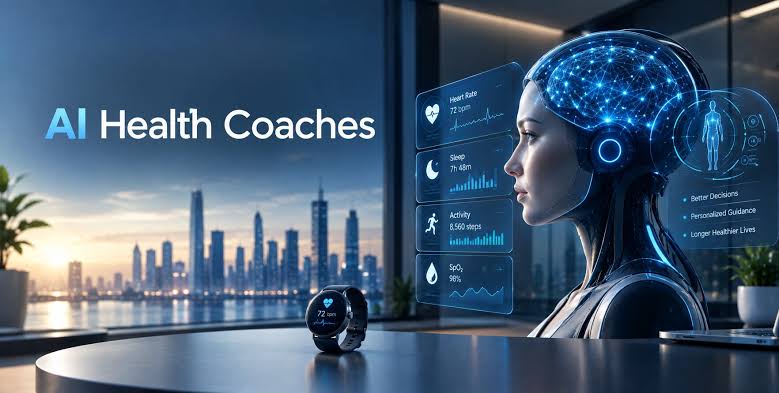
For years, the promise of wearable technology was relatively simple: collect more information about yourself.
A fitness tracker counted your steps. A smartwatch measured your heart rate. More sophisticated devices estimated blood-oxygen levels, tracked sleep and calculated how many calories you had burned. Open an app in the morning and you could find a dashboard filled with numbers describing what your body had been doing while you were asleep.
The problem was that most people still had to answer the difficult question themselves.
So what should I actually do about it?
That is the question the next generation of AI-powered health wearables is trying to answer.
Instead of simply reporting that you slept for five hours and 48 minutes, an AI coaching system can potentially look at your sleep, resting heart rate, heart-rate variability, recent exercise, previous behavior and other signals before recommending what you should do next.
Perhaps today is not the day for your hardest workout. Perhaps you should go to bed earlier. Perhaps your recent pattern suggests that you are not recovering as well as usual.
The wearable is no longer merely recording your life.
It is beginning to participate in it.
And that seemingly small transition — from measurement to recommendation — could turn out to be one of the most important changes in consumer health technology.
We Already Have More Health Data Than We Know What to Do With
The wearable industry has become remarkably good at producing numbers.
A modern device can potentially generate an enormous stream of information about its wearer: movement, workouts, sleep stages, skin temperature, resting heart rate, heart-rate variability and other physiological signals.
Yet collecting information and understanding it are two different things.
Consider heart-rate variability, or HRV.
Someone opening a health application might discover that their HRV has risen or fallen overnight. Unless they already understand what the measurement means, however, the number itself may be of limited value.
AI offers a possible solution.
Rather than presenting every measurement independently, an AI system can examine patterns across multiple signals and translate them into something closer to ordinary advice.
Instead of:
“Your HRV is lower than your recent baseline.”
the experience could become:
“Your recovery indicators are below your usual range today. Consider reducing training intensity and prioritising sleep tonight.”
That is a fundamentally different product.
The first is a dashboard.
The second is a coach.
The Most Important Feature May Be Memory
The obvious advantage of AI coaching is personalization.
Generic health recommendations have an unavoidable limitation. They are designed for populations, not individuals.
“Get eight hours of sleep.”
“Exercise regularly.”
“Walk 10,000 steps.”
These rules can be useful, but human lives are considerably messier.
One person may consistently function well after seven hours of sleep. Another may notice significant differences when they fall below eight. Someone training for a marathon has different recovery requirements from someone trying to become more active after years of sedentary work.
An AI wearable potentially has something even a human coach rarely possesses: continuous memory.
Imagine a device that has observed six months of your life.
It knows approximately when you sleep. It knows which days you exercise. It can recognize changes in resting heart rate. It can see whether your recovery metrics tend to deteriorate after several consecutive hard workouts.
Over time, the interesting question becomes less:
“What is considered healthy?”
and more:
“What is normal for you?”
That distinction could be enormously valuable.
A single unusual reading often means very little. A persistent deviation from someone's established baseline may be considerably more interesting.
The ambition, therefore, is not simply to put ChatGPT-like conversation inside a fitness application. It is to create an AI system with a continuously updated model of the person wearing the device.
From Dashboard to Conversation
There is another change happening at the same time.
Health apps have traditionally required users to interpret interfaces.
You open the application, navigate through charts, compare yesterday with last week and attempt to understand what happened.
Generative AI offers another interface entirely: conversation.
You might ask:
“Why am I so tired today?”
The AI could potentially examine your recent sleep and activity and explain that you slept less than usual, exercised heavily yesterday and have shown weaker recovery indicators for several days.
Or you might ask:
“Should I run this morning?”
Instead of providing a generic answer, the system could use the data collected by the wearable to provide context.
That could make health data accessible to people who have little interest in studying graphs.
But it also creates the central problem with the entire idea.
The more natural and confident the AI sounds, the easier it becomes to forget that it can be wrong.
When Does Coaching Become Medical Advice?
There is a relatively comfortable boundary when an AI says:
“You have been less active than usual this week.”
Things become considerably more complicated when it says:
“Your recent measurements suggest you should rest today.”
And they become more complicated still if consumers begin asking:
“Is something wrong with my heart?”
This is where the distinction between wellness technology and medicine becomes important.
Consumer wearables can provide useful information, and some wearable features have obtained regulatory authorization for specific medical functions. But an AI interpreting streams of consumer sensor data is not automatically equivalent to a physician evaluating a patient.
Sensors can produce inaccurate readings.
Algorithms can misunderstand context.
A strange night of sleep may have an innocent explanation. A change in heart rate could result from exercise, stress, illness, medication, alcohol, measurement error or numerous other factors.
An AI model does not necessarily know which explanation is correct.
Yet conversational AI creates a peculiar psychological problem: language can sound much more certain than the underlying data deserves.
A graph looks like a measurement.
A sentence sounds like an opinion.
And advice delivered in polished natural language can easily acquire more authority than it has earned.
The best AI health products may therefore need to become unusually good at saying three things:
Here is what we observed.
Here is what it might mean.
Here is what we cannot know from this data.
That third sentence could be the most important one.
The Risk of Becoming a Passenger in Your Own Body
There is another, subtler problem.
What happens when people begin trusting their wearable more than their own perception?
You wake up feeling energetic.
Your band says your recovery score is 42.
Do you exercise?
Or imagine the opposite.
The application says your recovery looks excellent, but you feel exhausted.
Which signal wins?
This is not merely hypothetical. Wearables already influence how some users think about sleep, exercise and recovery. AI coaching could intensify that relationship because the device would no longer merely display a score — it could explain the score, answer questions about it and recommend behavior.
There is a useful term for one version of this phenomenon: orthosomnia, where excessive concern about achieving supposedly perfect sleep data can itself contribute to sleep-related anxiety.
AI could reduce that problem by explaining noisy measurements more intelligently.
Or it could make it worse by turning every minor physiological fluctuation into a conversation.
A device designed to help us understand our bodies could, paradoxically, teach us to distrust them.
Your Body Is Extremely Valuable Data
Then there is privacy.
An AI health coach becomes more useful as it learns more about you.
That is also what makes it sensitive.
A conventional fitness application may know how many kilometers you ran.
A sophisticated health platform could potentially know when you normally wake up, how well you sleep, how frequently you exercise, changes in your physiological patterns and whether your routine suddenly changes.
Add information voluntarily supplied through an AI conversation — stress, diet, symptoms, alcohol consumption or personal goals — and the system begins constructing an unusually intimate portrait of its user.
That makes familiar technology questions considerably more serious.
Where is the information processed?
How long is it stored?
Can it be used to improve AI models?
Can users delete it?
Can it be shared with third parties?
What happens if the company is acquired?
What happens if the service shuts down?
A compromised social-media account reveals something about what you say.
A compromised health profile may reveal something about how you live.
Consumers deciding whether to trust an AI health coach should therefore evaluate more than sensor accuracy and battery life. Data governance may eventually become one of the most important features of the product.
The Real Competition Is for the Role of Trusted Adviser
The wearable industry has historically competed on hardware.
Who has the better sensor?
Who has the better battery?
Who can measure another physiological signal?
Those questions still matter. But AI changes the competitive landscape.
The winning health wearable may not necessarily be the device that collects the greatest number of measurements. It may be the one that turns imperfect measurements into the most useful guidance without pretending to know more than it does.
That requires something considerably harder than adding a chatbot.
A useful AI coach needs context.
It needs memory.
It needs reliable sensors.
It needs to understand uncertainty.
And, perhaps most importantly, it needs to earn trust.
Companies such as , , , WHOOP and Oura are all operating around pieces of this broader transition: increasingly sophisticated physiological tracking, personalized insights and software designed to transform raw measurements into understandable guidance.
The next battle may be over who gets to interpret the data.
The Screen May Eventually Matter Less
There is an even bigger technology story hiding underneath all of this.
For the past decade, much of the technology industry has assumed that the smartphone would remain the center of our digital lives.
AI wearables suggest another possibility.
Perhaps some of the most useful AI will not require us to stare at a screen at all.
A band quietly collecting signals from your body represents a different model of computing: persistent, contextual and largely invisible.
You do not necessarily need to tell the AI that you exercised.
It already detected it.
You do not need to enter the time you went to bed.
The device was there.
You do not need to explain that this week's routine differs from last week's.
The system has the history.
In that sense, the health band may be more interesting as an AI interface than as a fitness product.
Smartphones know an enormous amount about what we do digitally.
Wearables have the potential to know something smartphones struggle to understand:
what is happening to us physically.
Combine those signals with increasingly capable AI models and the result begins to resemble something the technology industry has pursued for decades — computing that understands context without constantly requiring instructions.
A Coach, Not a Doctor
There is enormous potential here.
Most people do not need another graph.
They need help turning information into better decisions.
If AI can take years of sleep, movement and recovery data and turn it into understandable, cautious and genuinely personalized guidance, wearables could become considerably more useful than today's fitness trackers.
But there is a line these systems should be careful not to cross.
A good AI health coach should help you understand your data without convincing you that it understands your body completely.
It should identify patterns without turning every anomaly into a diagnosis.
It should encourage healthier behavior without creating anxiety when you ignore its recommendations.
And it should know when the correct recommendation is not another AI-generated explanation, but a conversation with a qualified healthcare professional.
For years, technology companies have tried to persuade us to put computers everywhere: on our desks, in our pockets, in our homes and eventually on our bodies.
AI changes the proposition.
The computer on your wrist no longer wants merely to count your steps.
It wants to understand why you took them, determine whether you should take more tomorrow and persuade you to go to bed earlier tonight.
That could be extraordinarily useful.
But when a machine knows your heartbeat, your sleep and your habits — and starts telling you how to live — the most important question may no longer be what can it measure?
It may be:
How much should we listen?