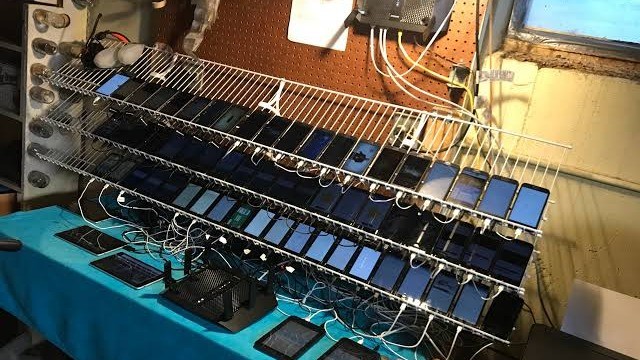
On a workbench, it can look almost absurdly simple: rows of smartphones packed tightly together, their screens glowing as they perform the same actions over and over again. Some setups use complete handsets; others use stripped-down phone boards mounted inside purpose-built boxes. Cables run between the devices and a computer or control system, turning what were once dozens of independent phones into something closer to a single machine.
The strange part is that there may be very little human activity involved.
A person does not have to sit in front of every screen. Software can coordinate many devices simultaneously, while automation can perform repetitive interactions. In more sophisticated operations, artificial intelligence can add another layer, helping generate content, manage accounts or automate conversations. What looks from the outside like a collection of ordinary smartphones can therefore function as a small industrial system.
This is the modern phone farm.
The technology has existed for years, but the economics are changing. Cheap hardware, readily available automation software, remote-controlled Android environments and AI are making it easier to operate large numbers of devices without requiring a corresponding increase in human labor. Human Security's Satori Threat Intelligence team recently documented an ecosystem in which physical phone hardware, cloud phones, orchestration software and AI could be combined into an increasingly accessible fraud infrastructure.
The result is an unusual transformation of the smartphone. A device originally designed to connect one person to the internet can be repurposed as a component in a machine designed to imitate thousands of people.
From click farms to phone farms
The basic idea is older than the smartphone.
Traditional click farms relied heavily on people. Workers would operate large numbers of accounts, manually clicking advertisements, liking posts, following accounts, leaving reviews or watching videos. The economics depended on cheap labor: one person could perform a limited number of actions, but hundreds of workers could produce millions.
Smartphones changed the equation.
Instead of needing a room full of people, an operator could increasingly assemble a room full of devices and automate repetitive actions. The phones were real, the operating systems were real and the applications were real. The machine was simply instructing them what to do.
That distinction matters because platforms have historically become better at detecting conventional bots. A request coming from a simple automated script is relatively easy to distinguish from normal activity. A real Android device behaving like a real Android device is more complicated.
Modern device farms therefore occupy an uncomfortable middle ground between hardware and software. They are physical enough to resemble genuine users, but automated enough to operate at a scale that genuine users cannot.
AppsFlyer describes phone farms as physical setups in which multiple devices are used to generate actions such as clicks, registrations, installs and in-app engagement, often for fraudulent purposes.
The objective is not always the same. Some operations have been associated with advertising fraud. Others manufacture social-media engagement, fake registrations, reviews or accounts. More sophisticated operations can support scams and other forms of fraud.
The common denominator is simple: one operator wants the internet to believe that many independent people are doing something when they are not.
Why use real phones?
The obvious question is why anyone would bother with dozens or hundreds of physical devices when software can already simulate users.
The answer is that real hardware can produce signals that software-only automation may struggle to reproduce convincingly.
A real smartphone has an operating system, hardware characteristics, sensors, network behavior and application environment. It behaves differently from a simple web script running on a server.
That does not make a physical device automatically legitimate. Modern fraud detection increasingly looks at groups of devices rather than individual devices.
A 2026 investigation by GeoComply described a case in which more than 1,000 apparent users could ultimately be traced back to dozens of automated devices. Individual signals were not necessarily conclusive, but the combination of unusual device characteristics, automation patterns and short-lived accounts revealed the underlying farm.
That is the central battle between phone farms and the platforms trying to stop them.
The farm is attempting to create the appearance of many independent people.
The platform is trying to determine whether those people are actually one machine.
The machine behind the phones
A mechanical phone farm does not necessarily look like a futuristic robot.
In many cases, the "mechanical" part is surprisingly mundane. Devices can be mounted into racks or boxes, connected through USB hardware and controlled from a central computer. Some commercially available systems use stripped-down phone motherboards rather than complete consumer handsets, reducing the space and cost required for each device.
Human Security's research into the so-called FunFoneFarm ecosystem found hardware assembled from inexpensive components, including salvaged phone motherboards, alongside software capable of orchestrating many devices.
That is important because it changes the economics.
A smartphone is normally a complete consumer product: screen, battery, casing, camera, speakers and other components all packaged for one person.
A phone farm does not necessarily need all of that.
If the objective is automated processing, the device can become a component.
The phone stops being a phone in the traditional sense.
It becomes a node.
A collection of nodes becomes a fleet.
And a fleet can be controlled as a single system.
The software is where the real power lies
The physical hardware attracts attention because it is visually strange. But the software is arguably more important.
A rack containing 100 phones is not particularly useful if somebody has to manually operate all 100.
The value comes from orchestration: software that allows an operator to manage many devices simultaneously.
Researchers studying modern phone-farm ecosystems have found increasingly sophisticated automation layers capable of coordinating devices and performing repetitive interactions. Human Security reported that some systems even incorporate AI, lowering the technical barrier for people who want to automate scams or social-media activity.
This is an important shift.
Automation used to require programming expertise.
Now, increasingly, the operator can describe what they want the system to do and let software generate or manage parts of the process.
That does not mean AI has magically solved every problem. Platforms still have sophisticated defenses, and automated systems can leave detectable patterns. But AI changes the economics by reducing the amount of specialized human labor required.
The machine is becoming easier to operate.
What are these farms actually trying to manufacture?
The answer depends on the operation.
Some phone farms are designed to manipulate advertising systems. Others are used to generate artificial social-media engagement. Others have been connected to fake accounts, fraudulent registrations or scams.
The underlying commodity is not really a click.
It is believability.
A single artificial click has little value.
Thousands of clicks that appear to come from thousands of independent users can have enormous consequences.
An advertiser might interpret the activity as evidence that a campaign is working. A platform might see a surge in engagement. An application might appear to have unusually strong adoption. A social-media account might suddenly look influential.
The fraud occurs because the signal is mistaken for genuine human demand.
Google defines invalid traffic as activity that does not come from a real user with genuine interest. Its AdSense policies specifically prohibit automated clicking tools, robots and other deceptive software used to generate artificial clicks or impressions.
That distinction is fundamental to the digital advertising economy.
Advertisers are not paying simply for numbers.
They are paying for the assumption that those numbers represent people.
The economics of fake attention
The internet has created an unusual market in which popularity itself can become a commodity.
Followers can be sold.
Views can be sold.
App installs can be sold.
Reviews can be sold.
Clicks can be sold.
Accounts can be sold.
The reason is that digital platforms rely heavily on behavioral signals. Popular content tends to receive more attention, while products with more reviews may appear more trustworthy. An application with thousands of downloads can appear more established than one with only a few hundred.
Artificial activity therefore attempts to create a feedback loop.
Manufactured engagement makes something appear popular.
Perceived popularity attracts genuine users.
Genuine users then create real engagement.
The operator hopes the artificial activity disappears inside the real activity.
This is why phone farms are more than an odd collection of smartphones. They represent an attempt to manufacture social proof.
And social proof has economic value.
AI is changing the business again
The most significant development may be what happens when phone farms are combined with artificial intelligence.
A traditional click farm might require workers to perform repetitive actions. A basic automated farm might require scripts to perform those actions.
An AI-assisted farm can potentially automate more complicated behavior.
Human Security's 2026 research describes an ecosystem in which AI can assist with automation and even scam conversations. The company argued that combining inexpensive hardware, orchestration software and AI is lowering the barriers to operating fraud at scale.
This is where the story becomes considerably bigger than fake likes.
A machine that can make a phone scroll is one thing.
A system that can operate accounts, generate convincing text and maintain interactions is something else entirely.
It begins to resemble a synthetic workforce.
Instead of paying hundreds of people to perform small digital tasks, an operator can increasingly combine hardware and software into an automated operation.
The economic implications extend far beyond social media.
The phone farm is becoming less physical
There is another twist: the future of phone farms may contain fewer phones.
Cloud-phone services allow operators to access remote Android environments without physically owning every device. Group-IB has described cloud phones as remotely accessible Android environments hosted in data centers that can behave more like mobile devices than traditional emulators. Researchers have warned that such systems are increasingly being used in financial fraud.
That means the physical phone farm could eventually become just one form of a much broader phenomenon.
The rack of glowing smartphones is easy to photograph.
The cloud version is much harder to see.
The hardware disappears into a data center, while the behavior remains.
This creates an uncomfortable possibility: the future of the phone farm may not look like a warehouse full of phones at all.
It may look like an ordinary cloud service.
And the platforms are fighting back
The arms race is already underway.
As farms become more sophisticated, platforms are examining increasingly subtle signals.
A device may appear legitimate on its own but suspicious when compared with hundreds of others. Timing patterns, account lifetimes, device configurations, network behavior and other characteristics can reveal relationships that are invisible at the individual-account level.
GeoComply's recent investigation illustrates this approach. Rather than relying on one definitive signal, investigators combined multiple weak signals to connect apparently separate users to the same underlying devices.
Google is also applying increasingly sophisticated machine-learning systems to advertising traffic. In 2025, Google said its systems had been improved with large language models to identify invalid advertising behavior and that one set of changes reduced invalid traffic associated with deceptive or disruptive ad-serving practices by 40% in its internal measurement.
The result is an arms race.
Every improvement in automation creates new detection problems.
Every improvement in detection creates an incentive to make automation look more natural.
And every improvement in AI potentially makes both sides more capable.
The strange future of the smartphone
The smartphone was supposed to make the internet more personal.
Instead, it is becoming one of the tools through which the internet can become less personal.
A real phone no longer necessarily means a real person.
A real account does not necessarily mean a real customer.
A real-looking interaction does not necessarily represent genuine interest.
That is the deeper significance of the phone farm.
It exposes a weakness at the center of the modern internet: many of the things we use to measure popularity are behavioral signals, and behavioral signals can be manufactured.
A view is supposed to mean somebody watched.
A like is supposed to mean somebody cared.
A download is supposed to mean somebody wanted the application.
A review is supposed to represent somebody's experience.
But if machines can manufacture those actions at scale, the numbers become less trustworthy.
The technology is therefore creating a strange new question for the digital economy:
How do you prove that a person is actually behind the activity?
The machine is not the real story
It is tempting to focus on the spectacle of hundreds of phones operating simultaneously. It makes for a striking photograph, and the hardware is genuinely fascinating.
But the real story is not the machine.
It is the economic system that makes the machine worthwhile.
Someone is willing to build the hardware because online attention has value.
Someone is willing to buy artificial engagement because visibility has value.
Someone is willing to sell automated accounts because identity has value.
And platforms are forced to spend enormous resources determining which activity is genuine because their businesses depend on trustworthy signals.
The phone farm simply sits in the middle of that system, converting cheap hardware and software into artificial human behavior.
The next generation will probably be even less recognizable.
There may be fewer physical phones, more cloud devices, more automation and far more AI. The machines may become better at behaving like people, while platforms become better at identifying machines.
The result will be an internet in which the most valuable commodity is not information, or even attention.
It may be authenticity.
And that is why the strange machine sitting on a workbench with dozens of glowing smartphones matters.
It is not merely a pile of phones.
It is a glimpse of what happens when the internet's most valuable human signals become something that machines can manufacture.