For much of the artificial-intelligence boom, investors have faced a difficult question: how long can the world's largest technology companies continue spending enormous sums on AI infrastructure before the investment starts producing an equally enormous financial return?
Microsoft may finally be providing an answer.
The company has spent heavily on data centers, GPUs, networking equipment and AI infrastructure as it attempts to turn Azure into one of the world's dominant platforms for artificial intelligence. That strategy has placed Microsoft at the centre of the AI investment boom, but it has also created a problem for shareholders: massive capital expenditure can generate impressive revenue growth while simultaneously putting pressure on margins and cash flow.
Microsoft's latest quarterly results offer an important sign that the equation may be beginning to change.
Azure revenue grew 48% year over year to $33.17 billion in the September quarter, exceeding analyst expectations. Microsoft's total revenue rose 20% to $92.28 billion, while adjusted earnings reached $4.89 per share. More strikingly, free cash flow reached $18.6 billion, around $10 billion above expectations.
That combination matters.
The AI story is no longer just about how much Microsoft is spending. It is increasingly about whether the company can turn that spending into a self-reinforcing economic engine.
Azure Is Becoming the Centre of the Story
Microsoft has several enormous businesses, from Windows and Office to gaming, enterprise software and LinkedIn. But for investors trying to understand the company's AI future, Azure has become the most important piece of the puzzle.
Cloud computing gives Microsoft something that many AI companies do not have: a direct way to monetize the enormous amount of computing required to train and operate AI models.
Every new AI application requires infrastructure. Models need computing power, storage, networking and software. Enterprises experimenting with AI need cloud capacity. Developers building AI agents need somewhere to run them.
Microsoft can sell all of that.
The latest numbers show that demand is still accelerating. Azure grew 48% in the latest quarter, and Microsoft expects Azure growth of roughly 49% to 50% in the current quarter.
That creates an unusually attractive position.
Microsoft is simultaneously selling the picks and shovels for the AI economy and embedding AI into the software products that businesses already use.
The Real Question Is Microsoft's AI Spending
There is, however, another side to the story.
Microsoft has committed enormous amounts of money to expanding its AI infrastructure. The company had forecast capital expenditure of roughly $190 billion for fiscal 2026, while quarterly capital expenditure in the latest period reached $45.2 billion.
Those numbers explain why investors have sometimes become nervous about the stock.
The AI boom has produced a strange financial cycle. Microsoft spends money building data centers. Those data centers provide computing capacity to customers. Customers then use that capacity to build AI products. If demand grows quickly enough, Microsoft generates enough revenue to justify the original investment.
But if AI demand fails to keep pace with infrastructure spending, the economics become much less attractive.
That is the fundamental debate surrounding Microsoft—and much of the technology sector.
The question isn't whether AI is real.
It is whether the revenue generated by AI will eventually justify the extraordinary cost of building the infrastructure required to support it.
Microsoft Has an Advantage Most AI Companies Don't
One reason Microsoft may be better positioned than many competitors is that it does not have to rely entirely on one AI product.
It has Azure.
It has Microsoft 365.
It has GitHub.
It has enterprise security.
It has Windows.
It has Dynamics.
And it has Copilot.
That distribution network is extremely valuable.
Microsoft can take AI capabilities and insert them into software that companies already purchase. An enterprise does not necessarily need to discover a new AI startup to begin using AI. It can simply activate new capabilities inside products it already has.
That creates a potentially powerful monetization model.
The company can sell AI infrastructure through Azure while simultaneously selling AI software through its productivity and enterprise applications.
The same customer can therefore generate revenue for Microsoft at multiple layers of the AI stack.
Copilot Has to Prove the Consumer Side of the Equation
This is where the story becomes more complicated.
AI infrastructure is already producing substantial revenue. But investors ultimately need to see whether AI applications can generate the kind of recurring, high-margin software revenue that historically made Microsoft such a powerful company.
Copilot is central to that experiment.
Microsoft is attempting to turn generative AI from an impressive technology into a recurring enterprise subscription and usage business.
The opportunity is enormous. Microsoft 365 is already embedded in millions of organizations. If AI becomes a standard feature of office work, Microsoft has a natural distribution channel that few competitors can match.
But there is a catch.
Businesses will not pay indefinitely simply because AI is fashionable.
They will pay if AI saves employees time, increases output, reduces costs or creates new revenue.
That means the next stage of Microsoft's AI story will be less about demonstrations and more about measurable productivity.
The OpenAI Relationship Is Both an Asset and a Risk
Microsoft's relationship with OpenAI has also become an important part of the investment story.
The partnership gave Microsoft an early and powerful position in generative AI, while Azure became a major infrastructure platform for OpenAI.
But the relationship also creates concentration risk.
Microsoft disclosed that OpenAI accounted for $24.1 billion of fiscal 2026 revenue, while OpenAI still owed Microsoft $6 billion in accounts receivable at the end of the fiscal year, according to reporting following Microsoft's results.
That does not mean Microsoft's AI growth is simply an OpenAI story.
In fact, one of the most important developments for Microsoft would be demonstrating that Azure's growth can continue even as the AI ecosystem becomes more competitive.
Google, Amazon and an expanding group of specialized AI infrastructure providers are all fighting for the same customers.
Microsoft therefore has to prove that Azure is becoming a general-purpose AI platform rather than simply an extension of its relationship with OpenAI.
The Stock's Valuation Is No Longer the Same Question
Microsoft's share price has experienced significant swings during the AI boom.
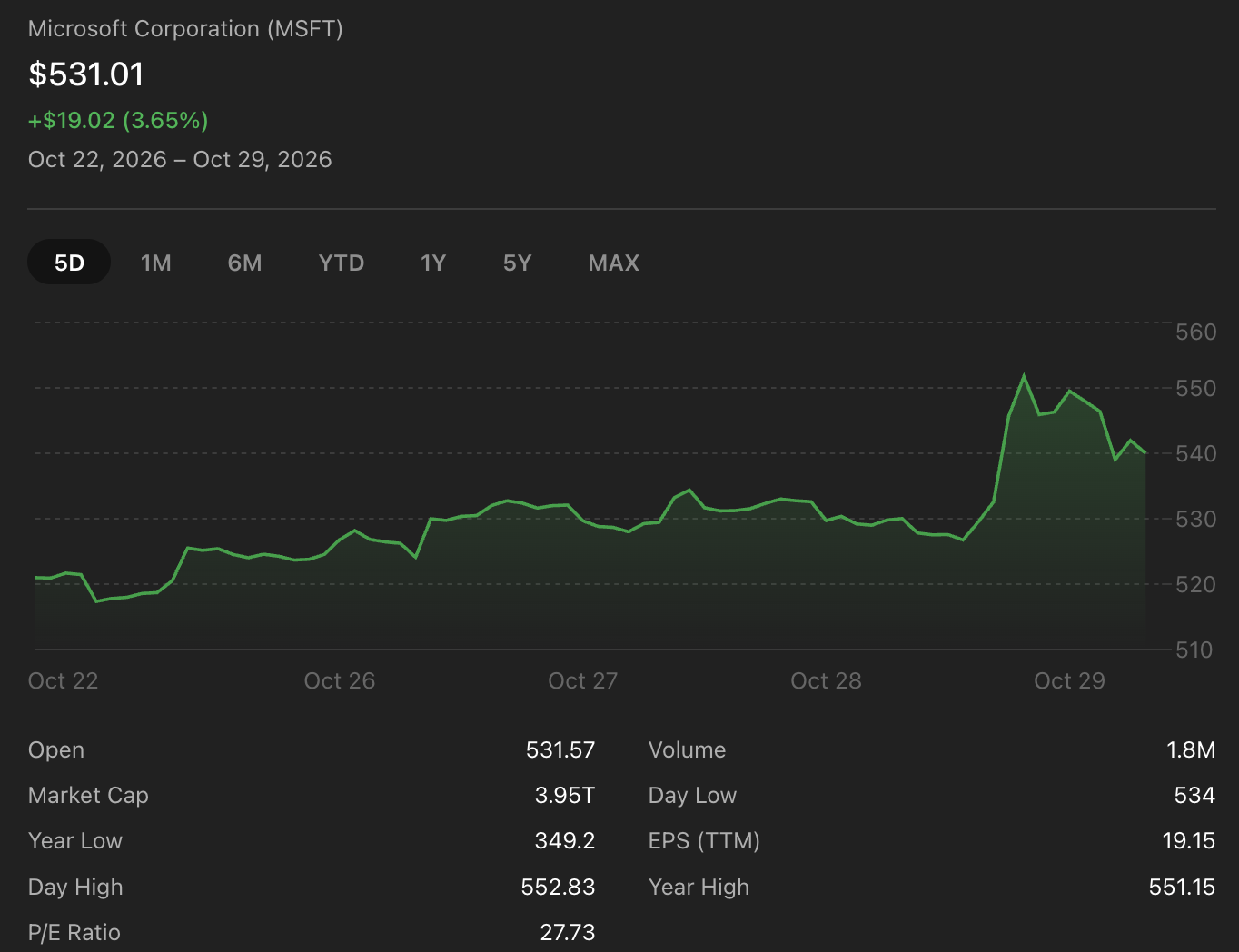
The company entered 2026 after a difficult period for the stock, with investors questioning whether Microsoft's enormous AI investment would generate adequate returns. Following its July results, however, shares staged one of their strongest rallies in years as Azure growth accelerated.
The latest results strengthen that recovery narrative.
At the latest market price, Microsoft has a market capitalization of roughly $4 trillion and trades at around 28 times earnings.
That is not a cheap valuation in absolute terms.
But investors are rarely valuing Microsoft as merely a mature software company.
They are valuing it as a company sitting at the intersection of cloud computing, enterprise software and artificial intelligence.
That distinction is crucial.
If Azure continues growing near 50%, Microsoft can potentially justify a much higher valuation than a conventional mature technology company. If Azure growth eventually slows dramatically while capital expenditure remains enormous, however, investors could begin questioning whether Microsoft's AI infrastructure has become an expensive asset rather than a competitive advantage.
The Biggest Risk May Be AI Deflation
There is another threat that is easy to overlook.
AI could become dramatically cheaper.
That sounds positive for customers, but it could create a complicated problem for infrastructure providers.
If new chips, software techniques and model architectures reduce the cost of running AI, customers may consume vastly more AI services. That could increase total demand for computing.
But the price of each unit of computation could fall at the same time.
Microsoft therefore needs AI demand to grow faster than computing economics deteriorate.
This is one reason Azure scale matters.
A smaller company may struggle if AI prices fall rapidly. Microsoft can potentially compensate through volume, software integration and cross-selling.
The company's enormous installed enterprise base gives it room to capture value even if individual AI services become cheaper.
Microsoft's Other Businesses Are Still the Safety Net
It is also important not to reduce Microsoft to an AI stock.
The company's traditional businesses remain extraordinarily powerful.
Microsoft 365 produces recurring subscription revenue. Windows remains deeply embedded in enterprise computing. GitHub has become a major platform for developers. Security is an increasingly important enterprise business. LinkedIn provides a large professional network. Gaming gives Microsoft another major consumer platform.
These businesses give Microsoft something that many AI companies lack: cash flow today.
That means Microsoft can invest in AI without depending entirely on external financing.
This distinction is becoming increasingly important as investors grow more concerned about the enormous amount of debt and capital required to finance the AI infrastructure boom. Reuters reported that major technology companies are expected to invest more than $700 billion in AI infrastructure in 2026.
Microsoft's balance sheet and existing businesses therefore give it an advantage if the AI boom becomes more expensive or volatile.
The Bull Case Is Becoming Easier to Understand
The bullish argument for Microsoft is relatively straightforward.
Azure continues growing rapidly.
AI demand remains strong.
Microsoft can monetize AI through cloud infrastructure and software.
Copilot can turn AI into recurring enterprise revenue.
Its existing businesses generate enormous cash flows.
And its scale allows it to spread AI infrastructure investments across a massive customer base.
If those conditions continue, today's enormous AI spending could eventually look less like speculative infrastructure investment and more like the construction of a new computing platform.
That would be a very valuable platform.
But the Bear Case Has Not Disappeared
The bearish argument is equally important.
Microsoft could be spending too much too quickly.
AI infrastructure could become commoditized.
Competition could compress cloud margins.
OpenAI concentration could become a problem.
Copilot adoption could disappoint.
AI customers could discover that many workloads are less profitable than expected.
And investors could decide that the returns on Microsoft's enormous capital expenditure are simply not high enough.
The biggest danger is therefore not that AI disappears.
It is that AI becomes successful but less profitable than investors currently expect.
The Microsoft Stock Question Is Really an AI Economics Question
This is why Microsoft stock has become one of the clearest ways to watch the broader AI investment cycle.
Nvidia tells investors how much infrastructure the industry is buying.
Microsoft provides a glimpse of what happens when that infrastructure reaches customers.
If Microsoft's revenue and free cash flow continue growing rapidly while capital expenditure becomes increasingly productive, the AI investment cycle starts to look sustainable.
If spending keeps rising while returns weaken, the market will eventually demand answers.
For now, Microsoft's latest results have given investors an encouraging answer.
Azure is growing rapidly. Total revenue is accelerating. Cash generation remains powerful. And the company is forecasting another quarter of roughly 50% Azure growth.
That does not make Microsoft stock risk-free, nor does it guarantee that today's valuation will produce strong returns from here.
But it changes the central question.
The debate is no longer simply whether Microsoft is spending too much on AI.
It is whether Microsoft has built enough of the infrastructure, distribution and software ecosystem to turn that spending into one of the most powerful technology businesses of the next decade.
For Microsoft shareholders, the AI revolution is no longer a promise. The company is beginning to show the receipts.
This article is for informational purposes and is not investment advice. Stock prices and valuations can change rapidly.