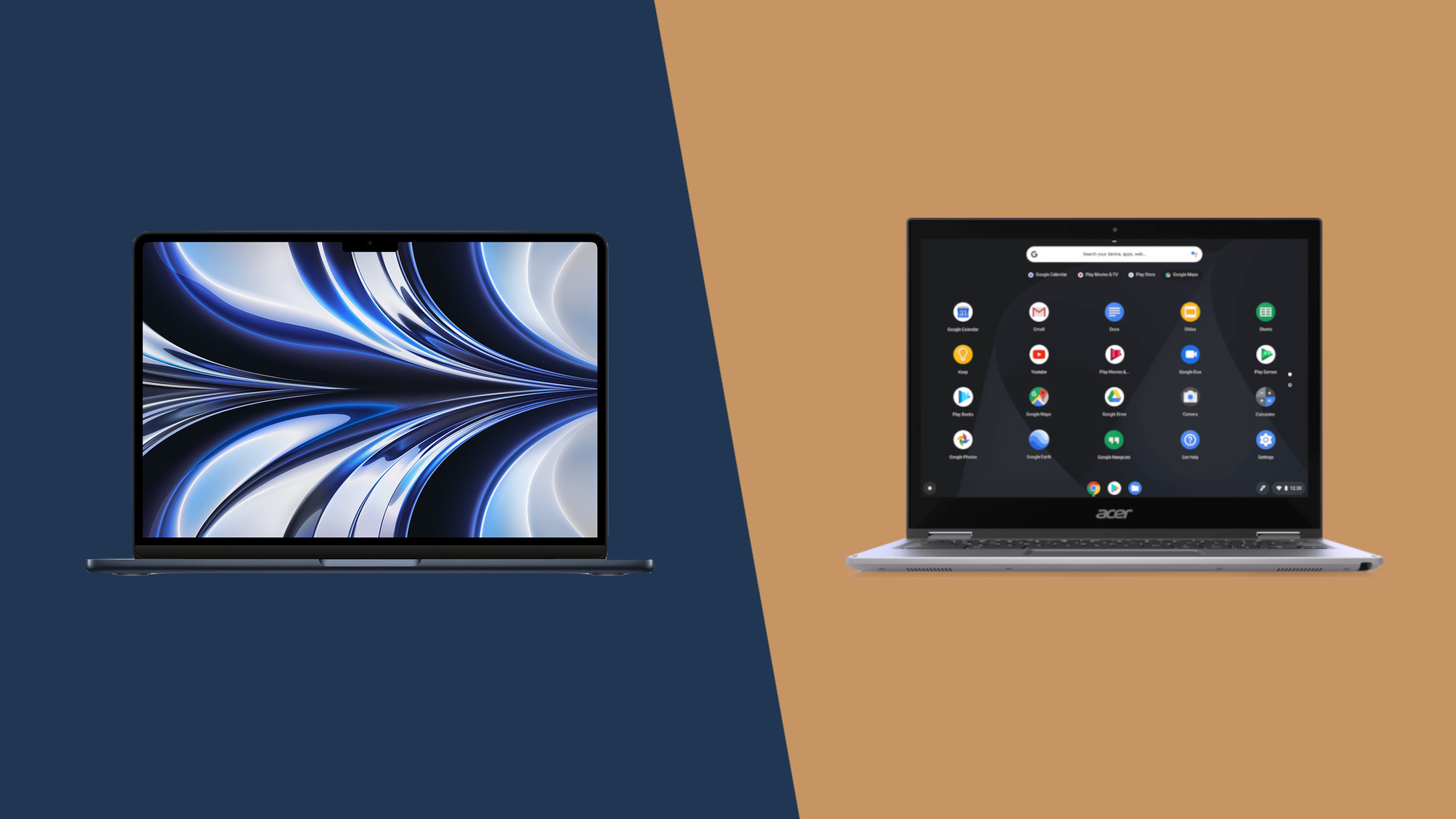
NEW YORK — Everyday consumers navigating the personal computer market face a widening divergence between Google's web-first Chromebook ecosystem and Apple's high-performance MacBook lineup, as contrasting hardware capabilities, long-term repair costs, and software architectures define buying decisions.
For shoppers seeking straightforward machines for routine internet tasks, the mechanical and financial gap between the two platforms has rarely been clearer. At the high end of consumer computing, Apple's proprietary silicon maintains an undisputed lead in sustained computational power. MacBooks equipped with M-series processors, including the M5 chip, deliver the bandwidth required for heavy multitasking, 4K video editing, and native artificial intelligence workflows. In retail and hardware analyses, the preceding MacBook Air M4 was widely characterized as a giant killer for its ability to produce desktop-grade performance inside a slim, fanless chassis. For creative specialists running software such as Final Cut Pro, Logic, or Adobe Lightroom Classic, and software developers who rely on native Unix-based developer tools, Apple laptops remain the decisive standard.
That specialized muscle is often superfluous for the average household. In a direct real-world benchmark published on Reddit in October 2025, an independent tester evaluated an M2 MacBook Air alongside two Chromebook Plus models across identical daily workloads. The testing showed that for standard web browsing, note-taking, student research, and 4K YouTube streaming, both platforms provided comparable everyday performance capable of serving mainstream users reliably for years. ChromeOS machines frequently outpace MacBooks in startup speed, reaching an active login screen in five to 10 seconds compared to 15 to 25 seconds on modern Apple hardware, an advantage attributable to Google's stripped-down operating system.
Gaming remains an ancillary consideration on both sides. MacBooks demonstrate superior graphical output compared to ChromeOS devices when running supported titles, yet neither line is primarily marketed to enthusiasts. Chromebooks depend almost entirely on lightweight Android titles or streaming services, while modern Mac gaming remains constrained by catalog compatibility.
Software architecture represents the primary philosophical divide. ChromeOS is engineered around the web browser, prioritizing rapid background updates, minimal user maintenance, and integrated security sandboxing. The system is purpose-built for users who operate primarily within Google Workspace or the browser-based edition of Microsoft 365. Google has extended ChromeOS by introducing Android app access through the Google Play Store and enabling Linux terminal containers for technical tasks, while ChromeOS Flex allows users to repurpose aging Windows machines into lightweight web terminals. ChromeOS has also added offline capabilities for Docs, Sheets, and Gmail, but its offline functionality remains visibly more limited than traditional operating systems. Specialized applications like the full Adobe Creative Suite or computer-aided design software do not operate natively on ChromeOS, requiring complex workarounds.
Apple's macOS provides an expansive local operating environment with deep support for native software packages and tight synchronization with the broader iOS ecosystem. The operating system handles complex local file hierarchies and heavy local workloads without relying on remote network connections, making it the practical choice for workers who need complete operational independence from the cloud.
The upfront financial investment highlights the biggest split for household budgets. On Google's official retail storefront, Chromebooks span from $179 for baseline educational hardware up to $799 for high-end configurations, undercutting the most affordable new Mac laptops by roughly $520. In Apple's retail channel, the standard 13-inch MacBook Air M5 starts at $1,299, while the 15-inch edition begins at $1,499, with both configurations providing 16 gigabytes of unified memory and a 512-gigabyte solid-state drive. Apple offers these configurations to educational buyers for $1,199 and $1,399, respectively. The entry-level MacBook Neo retails at $699, or $599 for qualifying students.
That entry-level Apple pricing reflects recent market volatility. Supply-chain reports indicate the MacBook Neo was initially planned to debut at a baseline price of $599 for the general public, but industry accounts indicate the figure was adjusted upward to $699 due to an alleged global shortage of memory components driven by artificial intelligence hardware demand.
In international retail channels, the price spread is even more pronounced. Retail listings published in mid-2026 by South African hardware supplier Evetech showed entry-level Chromebooks selling between 6,500 and 9,500 South African rand, whereas entry M-series MacBook Air units started above 23,000 rand, representing an upfront price ratio of three to four times. The repair calculus mirrors this disparity. According to repair shop estimates, out-of-warranty services for a damaged MacBook display assembly or logic board can exceed 10,000 rand. By contrast, damaged entry-level Chromebooks are routinely replaced entirely for between 3,000 and 6,000 rand, altering the financial risk profile for parents and budget-conscious offices.
When evaluating overall lifespan, buyers face an inverse relationship between software longevity and physical build quality. Google guarantees 10 years of automated security and operating system updates across its Chromebook catalog, surpassing the seven to eight years of major software support Apple typically accords to aging Mac models. Physical hardware durability presents the opposite picture. Because lower-tier Chromebooks use budget plastics and lighter hinge assemblies, industry assessments estimate their practical operational lifespan at four to five years under regular handling, extending to six or seven years for premium aluminum Chromebook Plus devices. MacBook Air units routinely survive seven to nine years of physical handling, while sturdier MacBook Pro enclosures often reach eight to 10 years.
Further shifts in the consumer laptop market remain on the horizon. Google is preparing a dedicated flagship laptop internally referred to as the Googlebook, forecast to arrive in late 2026. Official specifications, retail pricing, and the specific tier of the Gemini artificial intelligence model slated to power the Googlebook have not been publicly disclosed. At the same time, the historical separation between Apple and Google software experiences is narrowing in subtle ways. Both companies have confirmed that upcoming iterations of Apple Foundation Models will rely directly on Google's Gemini infrastructure, eroding the premise that selecting a MacBook over a Chromebook means choosing Apple's machine intelligence over Google's cloud computing.