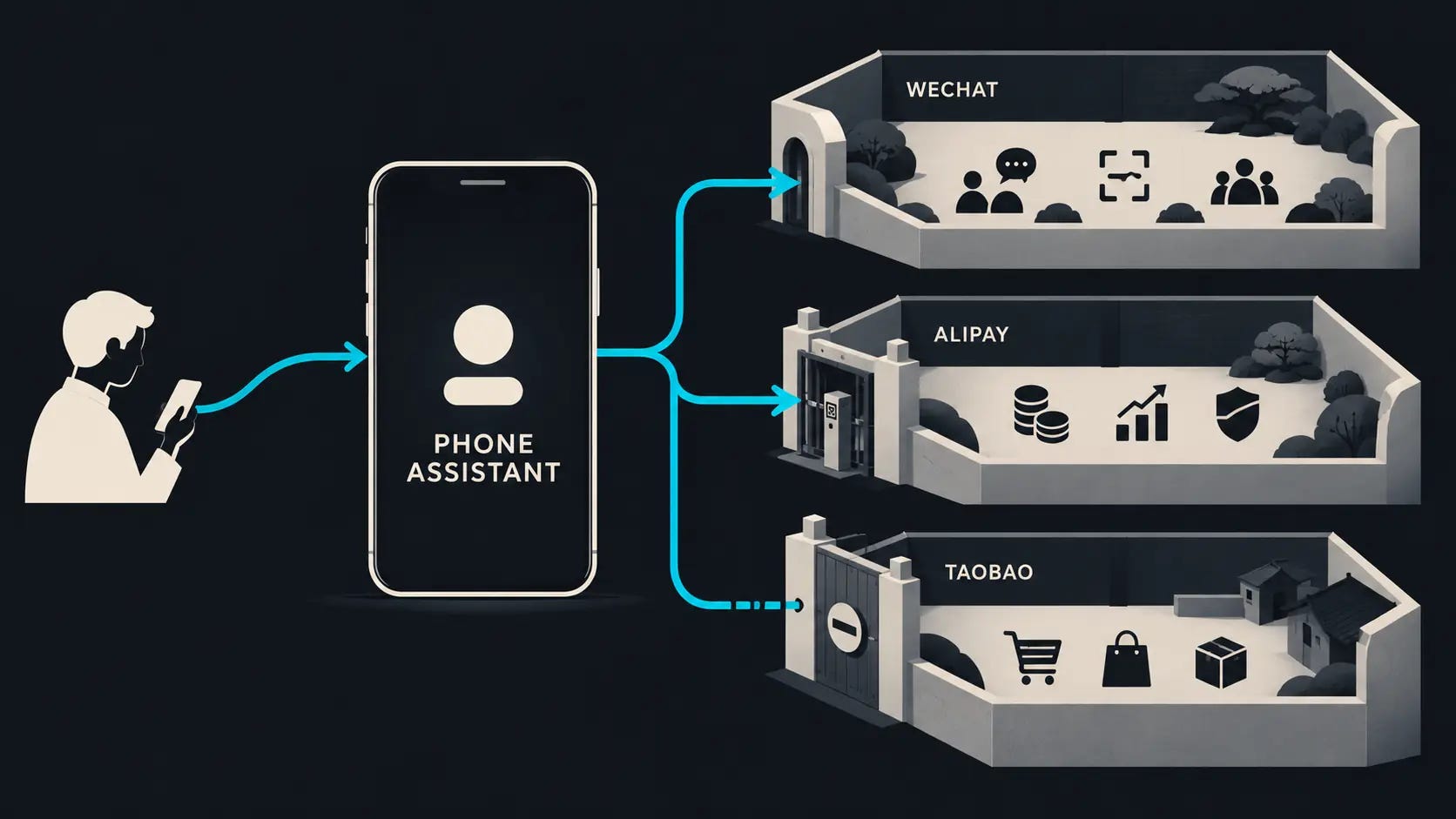
China’s telecom regulator has made app consent a condition for AI agents that operate smartphones. The new rules settle a year-long fight between ByteDance’s Doubao assistant and super-apps like WeChat and Alipay largely in the apps’ favour, and they add new checkpoints before agent features reach Chinese phones.
On November 6, China’s Ministry of Industry and Information Technology (MIIT) published a notice that brings phones, tablets and wearables with preinstalled AI agents under the country’s telecom equipment licensing regime. The notice, numbered 工信厅信管〔2026〕42号 and dated October 24, covers how agents are tested, how they are updated over the air, and, most consequentially, when they are allowed to operate other people’s apps.
The key sentence is short. App stores must get developers to declare, by electronic signature, whether they consent to being called by an agent, and “without declared consent, an agent may not forcibly call or access the app.” In practice, an assistant that taps through WeChat, Taobao or a banking app on a user’s behalf now needs two permissions: the user’s and the app maker’s. Silence counts as no.
What the notice actually requires
MIIT defines an agent as an intelligent system with “autonomous perception, memory, decision-making, interaction and execution” capabilities. An “agent terminal” is any telecom device, such as a phone, tablet or wearable, that ships with one preinstalled. The notice sets out four sets of obligations.
1. Compatibility testing, disclosed to users
Agent developers must verify that their agent works properly on each device it supports, covering permission calls, communications, network and data security, user rights and task execution. They must publish the list of verified device models and operating system versions on the agent’s settings page, and submit that verification to app stores before listing. App stores must show the same list on the download page and may not offer an agent to users whose devices are not on it.
2. Agent checks inside device licensing
Every phone sold for use on China’s public networks needs a network access licence (进网许可证) from MIIT. Devices with a preinstalled agent will now face agent compatibility verification during that testing, plus a fraud-risk security assessment and an evaluation of anti-fraud capabilities. Agents must carry a unique identity code, with reference to China’s national standards on agent interconnection. Manufacturers must keep licensed devices consistent with what was tested, and must report “major changes” to MIIT and retest as required.
3. Over-the-air agent upgrades go through MIIT
A manufacturer that upgrades an agent on phones already in users’ hands, through an over-the-air (OTA) software push, must first file an upgrade plan with MIIT. The plan has to cover timing, scale, target users, use cases, service content, business model, data security and anti-fraud measures. Once the upgrade is finished, the manufacturer files a report. Only after MIIT organises an expert assessment and solicits opinions can the service be “formally provided to users.”
4. App stores become the enforcement point
App distribution platforms collect developers’ consent declarations, display compatibility lists, and patrol listed agents. Agents that have not completed compatibility verification face deadlines to fix the problem or removal from the store. MIIT and provincial communications administrations will run routine and targeted inspections and handle complaints.
In a same-day explainer, MIIT framed the rules as building a full chain of “adaptation verification, network access testing, in-network upgrades and distribution management,” meant to provide an “inclusive and prudent” environment for AI phones while curbing “forced calling” of apps and protecting users’ right to know and choose. The notice does not state an effective date separate from publication, and it does not spell out penalties.
The fight this settles: Doubao versus the super-apps
The consent clause makes sense only against the backdrop of the past year. In December 2025, ZTE’s Nubia M153 launched with ByteDance’s Doubao Phone Assistant built in. Yicai reported that the device granted the assistant INJECT_EVENTS, a system-level Android permission normally reserved for manufacturer components, which lets software read the screen and simulate taps. Users soon reported being forcibly logged out of WeChat with a message about an “abnormal login environment,” and some banking apps prompted users to disable the assistant. Tencent said it had taken no deliberate action and that its security controls may have been triggered. ByteDance said the permission was used only with user consent and that the assistant would not perform payments or identity verification. Doubao’s team later disabled its ability to operate WeChat.
The standoff escalated in 2026. According to 21st Century Business Herald, ByteDance published a “Screen Automation Operation Declaration Protocol” in September with a 30-day notice period. Apps that did not explicitly agree would stay closed during that window, but afterwards Doubao could gradually open automation for apps that had neither agreed nor refused, based on each app’s risk level. When the window closed on October 14, Doubao published a list of apps that had explicitly refused. Sixth Tone reported more than 150; 21st Century Business Herald put the number at 155, including WeChat, Taobao, Alipay, Meituan and Xiaohongshu. That came weeks after Nubia launched its NaviX Ultra, which it markets as an agentic AI phone.
MIIT’s notice flips ByteDance’s default. Under Doubao’s protocol, an app that stayed silent could eventually be automated. Under MIIT’s rule, an app that stays silent cannot be. 21st Century Business Herald concluded that the notice establishes a “dual authorisation” principle at the regulatory level and “to some extent negates” the ByteDance protocol. That reading follows directly from the text, but how app stores implement declarations, and whether existing refusals carry over automatically, has not yet been specified.
Why “GUI agents” were the flashpoint
Phone agents complete tasks in two broad ways. The first uses an application programming interface (API): the app maker publishes a structured interface that defines what an agent can do, what data it can touch and how often it can call. The app stays in control, but the agent can only do what the app chooses to expose.
The second is graphical user interface (GUI) automation. A multimodal model reads the screen as a person would, works out which buttons to press, and simulates the taps. It works with any app, including ones whose makers never agreed to cooperate, which is why it is powerful and why app makers dislike it. A GUI agent with system-level permissions effectively holds the keys to every logged-in account on the phone, and it bypasses the app’s own view of who is acting.
Both sides have real arguments. App makers point to fraud and account security: an agent that can drive a payments app is also an attack surface, and China already has an Anti-Telecom and Online Fraud Law that MIIT cites as a legal basis for the notice. Agent makers argue that a consent requirement lets dominant platforms wall off their users and protect their own AI assistants. 21st Century Business Herald summarised that split, and a Tsinghua researcher told Cailian Press, as quoted by Sixth Tone, that apps’ refusals likely reflect both data-security concerns and a desire to protect their own AI ecosystems. MIIT has sided with the consent model while framing it in user-protection terms.
What changes for people buying AI phones in China
For users, the most visible change should be transparency. Agents will have to list supported devices in their settings, and app stores will refuse to install agents on unsupported models. That addresses a real problem: an agent that drives apps by reading the screen can break silently whenever a phone maker changes its interface.
The less welcome change is likely to be reach. If the 150-plus apps that refused Doubao keep withholding consent, the most useful cross-app tasks, such as ordering food, booking rides, paying and messaging through the dominant super-apps, will remain off-limits to third-party agents unless those platforms open APIs or sign deals. Assistants built by the platforms themselves, or by phone makers that strike agreements with them, stand to gain.
Software cadence is the third change. Chinese phone makers have competed on frequent AI feature drops. Requiring a filed plan, a post-upgrade report and an expert review before agent upgrades are “formally” offered adds a checkpoint that ordinary app updates do not face. The wording leaves room for interpretation; it reads like a staged rollout that ends in regulatory sign-off rather than a ban on pushing code. The practical delay will depend on how quickly MIIT processes filings, which nobody outside the ministry can yet measure.
The fraud-assessment and identity-code requirements also point to the regulator’s underlying worry: that agents acting on a user’s behalf could be hijacked or impersonated to move money or send messages. A unique, registered identity for each agent gives authorities and apps a way to tell an agent’s actions apart from a human’s, which current GUI automation deliberately blurs.
A different answer from the United States
The same conflict has played out in the US, with the opposite result so far. Amazon sued Perplexity in November 2025 over its Comet browser agent shopping on Amazon on users’ behalf. On August 4, 2026, the Ninth Circuit vacated a preliminary injunction against Comet, reasoning that the agent acted as a tool of the human user rather than as a separate party accessing Amazon’s systems. That ruling did not end the case or create a general right for agents to access sites, but it leaned toward user authorisation being enough.
China has now written the opposite default into telecom licensing: user consent is necessary but not sufficient. Because MIIT controls whether a phone can be sold for China’s networks at all, the rule reaches every domestic handset maker shipping agent features, along with any foreign brand that wants to put an agent on a China-licensed device. Export-only models that never seek a Chinese network licence are not obviously covered.
What remains unclear
- Timing and penalties. The notice cites existing laws but gives no compliance deadline or penalty schedule. Devices already on sale may or may not need retesting.
- Standards. MIIT says compatibility standards and a trusted agent identity system are still being built, with the China Academy of Information and Communications Technology developing a compatibility database. The details will determine how burdensome testing becomes.
- Downloadable agents. Licensing rules bite on preinstalled agents, but the compatibility and consent provisions also cover agents distributed through app stores. Whether sideloaded agents fall outside that net is not addressed.
- API pressure. Consent rules could push platforms to offer sanctioned APIs on their own terms, or simply entrench refusals. Watch whether Tencent and Alibaba open agent interfaces to rival assistants.
The deeper question is who will own the agent layer on the world’s largest smartphone market. MIIT has not picked a winning company, but it has picked a rule: on Chinese phones, the app that holds the user’s account gets a veto over the AI that wants to act for them. Every agent maker, from ByteDance to the handset brands, will now have to negotiate for access instead of reading the screen and tapping through without it.