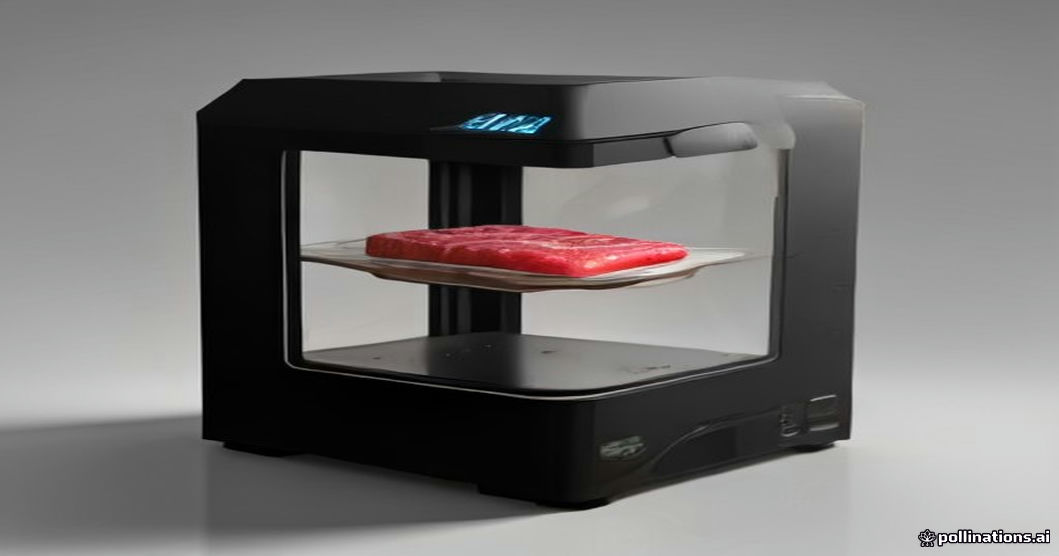
NEW YORK — The future of dinner might not involve a butcher shop or a farm, but a sophisticated machine meticulously constructing your meal. Imagine a steak materializing before your eyes, a nozzle precisely extruding edible pastes layer by layer, building a fibrous structure designed to replicate the muscle and intricate marbling of fat found in a conventional cut. This isn't science fiction; it is the rapidly developing reality of 3D-printed food, a technology that is moving from niche innovation to a potential staple on our plates.
This additive manufacturing process, akin to how plastic objects are printed, uses edible ingredients to craft complex food items. The journey begins with a digital blueprint, a precise model that guides the printer on the desired shape, structure, and internal composition. Next, food-grade "inks" or pastes are prepared, formulated from various ingredients like purees, doughs, gels, or mixtures of proteins and fats. For meat alternatives, these are engineered to possess specific rheological properties—viscosity and elasticity—essential for stable extrusion. The printer then extrudes these prepared ingredients layer by layer, building the product from the ground up. Advanced multi-nozzle systems can combine different materials within a single product, allowing for complex designs and varied nutritional profiles. After printing, the food often undergoes post-processing, such as cooking, cooling, or packaging, to ensure safety, achieve desired textures, and enhance flavor. Some cutting-edge systems are even exploring simultaneous printing and cooking using lasers or infrared technology.
The precision of 3D printing allows for intricate textures and structures that are difficult or impossible to achieve manually or with traditional forming machines. For instance, it can lay down protein fibers in specific directions alongside streaks of fat, recreating the complex mouthfeel and bite of a real steak, a level of detail that could fundamentally alter our perception of engineered food.
It is crucial to distinguish between two fundamentally different approaches to 3D-printed meat, both vying for a place in the market. First, there is **plant-based 3D-printed meat**, which utilizes plant proteins and other ingredients to mimic the taste, texture, and appearance of conventional meat. Companies like Israel's Steakholder Foods and Redefine Meat are leading in this area. Steakholder Foods, for example, employs high-quality plant proteins such as soy and pea, natural fats, and flavor enhancers to create products like marbled steak, filet mignon, chicken breast, and salmon and white fish patties. Their goal is to recreate the fibrous textures and marbling features that maintain flavor and juiciness. In September 2026, Steakholder Foods announced a U.S. retail launch for its Perfecta brand, targeting grocery stores in the Northeastern U.S., a significant step towards wider consumer availability. They are also partnering with Wyler Farms to produce plant-based beef steaks at an industrial scale using their 3D Fusion Pro meat printer.
The second approach is **cultivated, or cell-based, 3D-printed meat**. This involves growing real animal cells—for instance, from a cow or chicken—in a laboratory environment to form muscle tissue, which is then structured using 3D bioprinting. These cultivated cells are layered with edible "bio-inks" that mimic the texture and structure of animal muscle. Bio-inks can include scaffolds made from plant-based materials like alginate, derived from seaweed, or lab-synthesized collagen. This process aims to create meat that possesses the same cellular composition as a raw cut of conventional meat, including fat cells (adipocytes) for flavor and skeletal muscle cells for texture. Companies like Aleph Farms are actively working on cultivating and cooking steaks for astronauts using pluripotent stem cells. In a major regulatory milestone, Good Meat and Upside Foods have already received U.S. Food and Drug Administration (FDA) and U.S. Department of Agriculture (USDA) approval for their lab-grown chicken products, which are now being sold in select U.S. restaurants.
To reproduce the complex characteristics of conventional meat, 3D printing relies on a sophisticated blend of ingredients. For the "muscle" component in plant-based options, proteins from soy, pea, wheat, rice, and potato starch are commonly used to form structural fibers. In cultivated meat, actual muscle cells grown in bioreactors are the primary component. "Fat" is incorporated into plant-based formulations using natural fats, while in cultivated meat, adipocytes are grown alongside muscle cells to provide the characteristic marbling and juiciness. "Texture" is achieved using protein gels, alginate, and other plant-based materials as structural components and scaffolds. The layer-by-layer deposition process itself is fundamental to building complex, fibrous textures that mimic real meat. Additives like guar gum can be used to formulate food inks with appropriate rheological properties for stable extrusion. Finally, "flavor and color" are crucial. Flavor enhancers are vital for both plant-based and cultivated products, and beetroot extract can be used to achieve a meat-like color. For specialized applications, such as space missions, inkjet technology is being developed to deliver micronutrients, flavor, and smell with precision.
Several entities are at the forefront of this rapidly evolving field. Beyond Steakholder Foods and Redefine Meat in Israel, Spain's Novameat is another pioneer in plant-based 3D-printed steak. Austria's Revo Foods has developed 3D-structured plant-based salmon filets, which are among the first 3D-printed food products available in European supermarkets. Revo Foods is also building a "TASTE FACTORY" with the ambitious goal of producing up to 60 tons of product per month, signaling a move towards large-scale 3D food printing. Natural Machines, also from Spain, created the Foodini printer, aiming to bring 3D-printed food to home kitchens. Companies like Chocola3D from Ukraine and Bulgaria, and Print2Taste from Germany, are established in the market, with Chocola3D's printer capable of processing over 26 different materials, including chocolate, cheese, meat, and pea protein. On the research front, BeeHex, a NASA spin-off company in the U.S., designed a Universal Food Fabricator (UFF) for space missions and has adapted its Chef 3D device for commercial applications like decorating cookies and printing custom breakfast bars. The Systems and Materials Research Corporation (SMRC) in the U.S., backed by NASA, is developing a complete nutritional system for long-duration space missions, combining 3D printing for macronutrients and inkjet for micronutrients and flavors. Researchers at Southern Illinois University Carbondale, funded by the NASA Deep Space Food Challenge, developed "µBites," 3D-printed cookies from plastic waste using yeast. Columbia University researchers are exploring 3D printing for desserts like vegan cheesecake, incorporating laser cooking technology, while food technologist Mario Jekle at the University of Hohenheim in Germany is researching the technology's potential for customized products and specific nutritional needs. The U.K.'s Nourished uses 3D printing to create personalized vitamin gummies tailored to individual nutritional needs.
The versatility of 3D food printing extends far beyond steak. Companies are producing plant-based salmon, white fish patties, and chicken breast. Intricate chocolate sculptures, personalized messages, and various types of chocolate are being printed, alongside vegan cheesecakes and cookies. Chefs can create custom pasta shapes, including initials, logos, or miniature sculptures, offering unique dining experiences; Barilla has notably invested in customized pasta printing. Personalized nutrition is a major application, allowing for vitamin gummies with custom nutrient blends or meals tailored to dietary restrictions, allergies, or health data from fitness trackers, providing precise portion control and nutritional balance. Hospitals and care homes are exploring 3D-printed "smoothfood" for patients with dysphagia (difficulty swallowing), creating visually appealing, soft, easy-to-swallow meals with precisely controlled nutrients. This can also cater to specific needs for diabetic patients, providing soft textures and personalized nutritional compositions. Even drinks and cheese are seeing innovation, with companies printing ingredients inside cups for self-stirring drinks, and researchers successfully 3D printing cheese with modified textures.
Despite these advancements, 3D food printing currently remains a relatively costly and niche technology, primarily used for small-scale production and prototyping. The equipment costs are high, and production volumes are low, making 3D-printed alternatives more expensive than conventional ground-meat substitutes. Printing complex dishes layer by layer is time-intensive, leading to slower production speeds compared to traditional methods. However, the industry is rapidly evolving. The global 3D printed meat market is projected to grow significantly, transitioning from an emerging technology to a high-impact commercial reality between 2025 and 2035, with an impressive compound annual growth rate (CAGR) of 26.6%. This growth is driven by sustainability pressures, technological innovation, and the rising demand for alternative proteins. The practicality of 3D printing and the potential for lower costs could eventually pave the way for it to address global food issues.
The ability to customize food with unprecedented precision opens up numerous possibilities across various sectors. High-end restaurants are already using 3D printers to create intricate designs, enhance plating, and offer unique, customized dishes that would be impossible to craft by hand. This allows chefs to experiment with new textures, shapes, and flavors, leading to novel dining experiences, with some avant-garde restaurants in Barcelona reportedly printing entire tasting menus. For hospitals and care homes, 3D printing offers a transformative solution for patients with specific dietary needs, producing meals with precisely controlled protein, vitamins, calories, and textures for individuals with conditions like dysphagia or diabetes. This ensures patients receive adequate nutrition in an appealing and easy-to-consume format, combating malnutrition often seen with traditional institutional food. For long-duration space missions, 3D food printing is seen as a game-changer. NASA and companies like SMRC are developing systems to provide astronauts with personalized nutrition, variety, and extended shelf life for food made from powdered or freeze-dried ingredients. This technology can minimize waste, which is crucial in resource-limited environments, and address the psychological impact of monotonous diets by offering diverse and visually appealing meals. Projects like µBites even explore creating protein-rich cookies from plastic waste for deep-space exploration.
One of the most compelling arguments for 3D-printed meat is its potential to significantly reduce the environmental footprint of food production. Studies, such as one by the University of Oxford, suggest that 3D-printed meat production could result in up to 96% lower greenhouse gas emissions compared to traditional livestock farming, as it eliminates the need for large-scale animal breeding, transportation, and feed production. Livestock farming currently contributes approximately 14.5% of total global greenhouse gas emissions. The technology also has the potential to drastically reduce land occupation and water usage associated with conventional meat production, which often leads to deforestation and water pollution, with lab-grown, printed meat potentially reducing resource usage by up to 90%. Furthermore, by precisely dispensing only the exact quantity of ingredients needed, 3D printing can cut food waste by 10-30%. For space missions, the advantage of zero waste is particularly significant. However, the environmental benefits of cultivated meat are still under scrutiny. A non-peer-reviewed intradepartmental study from the University of California, Davis, in May 2023, alleged that lab-grown meat might be between four and 25 times worse for the environment than natural, pasture-raised cattle or retail beef. This is primarily due to the energy-intensive purification process required for the animal cell growth medium, highlighting the need for developing less refined and more environmentally friendly growth media.
3D food printing also holds promise for addressing global food insecurity and malnutrition. It offers a scalable and efficient method of food production, particularly valuable in regions prone to natural disasters or lacking access to transport and fresh food. The technology allows for customization to ensure adequate nutrient intake based on individual dietary requirements, helping to realign nutrient-deficit diets. For instance, combining staple carbohydrates like rice with 3D-printed dissolvable stock cubes providing essential nutrients could combat malnutrition cheaply and efficiently. Its portability and ability to produce on-demand nutrients make it invaluable during crises. While the technology is currently expensive, its potential for lower production costs in the future could make it accessible to a wider range of countries. However, initially, the cost and technological requirements might make it more accessible to wealthy countries. The development of low-cost, portable 3D-printed sensors could also improve food safety monitoring in vulnerable communities.
Despite rapid advancements, several significant hurdles remain for mass adoption. Price is a major obstacle, as 3D food printers and specialized ingredients are currently expensive, making the end products costly. Only a small percentage of consumers are willing to pay more for 3D-printed meat than conventional meat, with many viewing it as a luxury. Production speed is another challenge, as current 3D printers operate much slower than traditional food production methods, posing a barrier for industrial-scale output and meeting high demand. For cultivated meat, the energy required for purifying cell growth media is a significant concern, potentially making it less environmentally friendly than initially thought. The regulatory landscape is still developing; in the EU, 3D-printed foods fall under the Novel Food Regulation, requiring safety assessments. In the U.S., the FDA is referencing existing frameworks for 3D-printed medical products, but a dedicated regulatory framework covering raw materials, equipment, hygiene, and labeling is needed. Food safety concerns include microbial growth in printer components, cross-contamination, the need for post-processing (cooking/pasteurization), and the potential for toxic particles from some printer materials. The reliance on chemical additives like stabilizers and thickeners to ensure printability is also a challenge. Consumer acceptance remains a significant hurdle, as many consumers are skeptical about the taste, nutrition, and "naturalness" of 3D-printed food. Building trust through clear communication about safety and benefits is crucial. A 2025 survey in Germany showed that 24% of people could imagine eating cultivated meat produced using a 3D printer, up from 13% six years prior, indicating a gradual shift. Technical limitations include achieving consistent printability and structural integrity, as food inks need precise rheological properties and stability. The integration with existing manufacturing processes and the development of an ecosystem for supporting industries, such as food cartridge manufacturers and downloadable recipe design files, are also ongoing challenges. There is also a shortage of clearly defined customer segments and effective profit strategies.
While 3D-printed food, particularly steak, is still largely a niche technology, it is rapidly approaching commercial viability and wider adoption. Steakholder Foods' launch of its Perfecta brand of plant-based 3D-printed products in U.S. grocery stores in late 2026 is a significant step towards mass adoption. The market for 3D-printed meat is expected to see "extraordinary expansion" and transition to a "high-impact commercial reality" by 2035. However, widespread household use is still estimated to be five to ten years away, partly due to cost, production speed, and the lack of a robust supply chain for refill packs. The technology's current strengths lie in customized products or small production runs, such as intricate patisserie items or specialized hospital meals. The focus is shifting from merely mimicking meat to leveraging the technology's ability to precisely control food structure, allowing customization of protein content, fat distribution, texture, and nutrition.
If machines can eventually reproduce the taste, texture, and nutrition of conventional food at scale, the implications for farms and kitchens could be profound. The need for extensive livestock farming could diminish significantly, potentially freeing up vast tracts of land and reducing water consumption and greenhouse gas emissions. This could lead to a paradigm shift in land use, potentially allowing for rewilding or alternative agricultural practices. However, it also poses a strong blow to rural economies and raises concerns about the conservation of domestic species if not managed carefully. Both commercial and home kitchens could be fundamentally transformed. Restaurants might become hubs for culinary innovation, printing bespoke dishes on demand. Home kitchens could feature personal food printers, allowing consumers to print customized meals tailored to their exact nutritional needs, dietary preferences, and even health data. This could mean less reliance on traditional cooking methods and a shift towards "digital cooking." The concept of "food architects" and "food designers" could become mainstream, with digital recipes and food cartridges replacing traditional ingredients and cooking techniques. The future could see a world where food production is decentralized, highly personalized, and significantly more sustainable, but it will require overcoming substantial technological, economic, and societal challenges, including consumer acceptance of food that doesn't originate from a farm in the traditional sense.