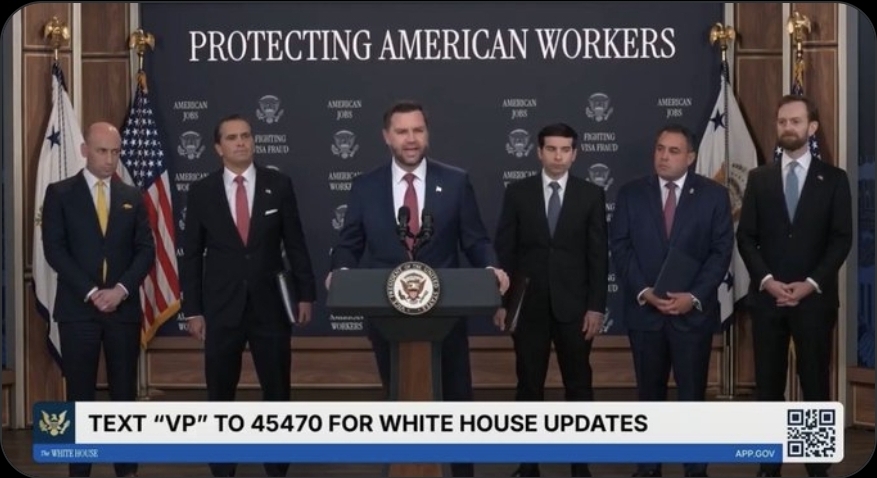
The United States government today, October 8, 2026, announced the immediate suspension of eight prominent technology companies from the Permanent Labor Certification (PERM) program, a critical first step for employers seeking to sponsor foreign workers for employment-based green cards. The affected companies are Microsoft, Adobe, Tata Consultancy Services (TCS), Infosys, Wipro, HCL, Cognizant, and Capgemini.
The announcement was made by Vice President JD Vance and Labor Secretary Keith Sonderling during a White House press conference, with Reuters among the outlets reporting the significant development. The suspension means that the Department of Labor will no longer accept new PERM applications from these companies, nor will it process any pending applications involving them.
Labor Secretary Keith Sonderling specifically named Cognizant, Infosys, Tata Consultancy Services, Wipro, HCL, and Capgemini as being suspended from the PERM program. Microsoft and Adobe were also included in the suspension due to what officials described as "multiple active federal investigations."
Vice President Vance stated that the drastic action was taken to ensure that companies prioritize hiring American workers and to address what he termed as alleged abuse of the green card pathway. He accused Microsoft of significant abuse of the system, alleging that the company laid off 6,000 American workers in 2025. Simultaneously, Vance claimed, Microsoft obtained over 6,000 H-1B visa approvals and filed 3,682 PERM applications, nearly 1,000 of which were for positions involving workers it had recently laid off.
Vance further asserted that companies were exploiting the green card pathway to hire cheaper labor, thereby undercutting American workers. Labor Secretary Sonderling supported this sentiment, noting that since 2009, the suspended companies collectively requested almost three million foreign workers. He added that these companies received over 230,000 H-1B visa approvals and more than 100,000 permanent labor certifications, which he argued represented "hundreds of thousands of jobs that were taken from American workers."
The suspension is rooted in allegations of widespread fraud within the PERM program. Anthony D'Esposito, the Labor Inspector General, confirmed that subpoenas had been served as part of an ongoing nationwide H-1B and PERM fraud investigation. This investigation, which commenced in July, is reportedly examining fraudulent applications, wage kickbacks, and a practice known as "benching," where employees are kept on the payroll but not assigned work, often to maintain visa status.
In a related development, the Justice Department reportedly recovered $3.2 million from OpenAI in August concerning how the artificial intelligence company advertised PERM roles. The scope of federal scrutiny extends beyond the tech sector, with nine universities, including prestigious institutions like Harvard, Yale, and Stanford, also under investigation. These universities are alleged to have misused the J-1 exchange visitor program to undercut American wages, and subpoenas have already been served in those cases.
Microsoft, in its initial response to the suspension, stated that it believes in the "strength and talent of the American workforce" and emphasized that the vast majority of its US employees are Americans. The company also noted that 80% of its H-1B visa applications in the last fiscal year were for existing employees seeking to extend or change their status, and new hires through this program represented only 1% of its US workforce.
The exact duration of the suspension for these eight companies has not yet been made public by the government. While the suspension immediately impacts new PERM filings, officials clarified that cases already filed or approved are not being canceled, and no one's current visa status changes as a direct result of this announcement.
As of the reporting date, no criminal charges have been brought in connection with the ongoing labor investigation. The wider implications for the long-term immigration plans of foreign professionals, particularly Indian technology workers whose primary path to permanent residency depends on employer-sponsored green cards, remain to be fully seen. The current year, 2026, has already seen ongoing discussions and proposed changes to H-1B and green card pathways, including a potential reclassification of Adjustment of Status as a discretionary benefit rather than a routine step, and a modernization of the PERM labor certification process. These broader policy considerations underscore the evolving landscape of US immigration for skilled workers.