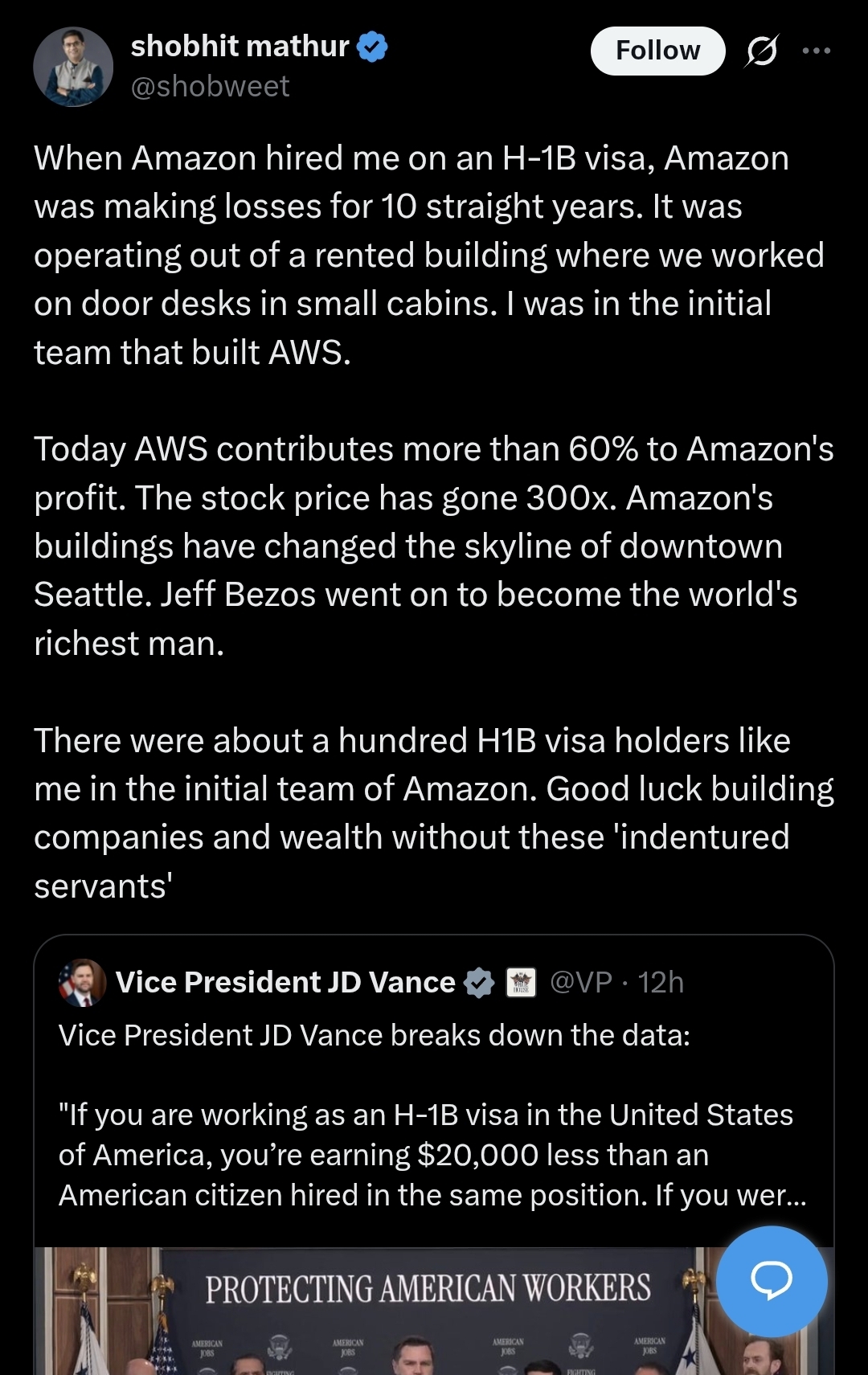
Vice President JD Vance has become a prominent critic of the H-1B visa program, asserting that it allows corporations and foreign outsourcing firms to exploit foreign workers, depress wages, and replace American employees. Vance claims that H-1B workers in the United States earn approximately $20,000 less than American citizens in comparable positions, a figure he attributes to "basic data." He further alleges that workers brought in by foreign outsourcing firms earn about $48,000 less than their American counterparts. This system, Vance argues, enables corporations to cut labor costs by importing what he has termed "indentured servants," often while simultaneously laying off American employees. He has specifically cited Microsoft, alleging the company laid off 6,000 American workers while benefiting from 6,300 H-1B visas and nearly 10,000 permanent labor certifications.
This perspective stands in stark contrast to the experiences shared by individuals like Shobhit, whose personal account highlights the program's perceived benefits. Shobhit reportedly joined Amazon during its nascent years, a period when the company was said to be struggling financially. He claims to have helped build Amazon Web Services (AWS) alongside approximately 100 H-1B visa holders, arguing that this immigrant talent was instrumental in creating a business that became a major source of Amazon’s profits and contributed to enormous shareholder wealth. While Shobhit’s specific account of 100 H-1B visa holders at AWS’s founding could not be independently verified from available records, his narrative reflects a broader argument about the role of skilled immigrants in American innovation.
Investigating the wage gap claims reveals a complex picture with varying research findings. Vice President Vance's specific figures of $20,000 and $48,000 less for H-1B workers and those from outsourcing firms, respectively, are widely cited in his criticisms, though the precise studies or datasets he references for these exact numbers were not detailed in the available reporting. However, other academic research does point to a wage differential. A February 2026 working paper by George J. Borjas for the National Bureau of Economic Research (NBER) found that, on average, H-1B workers earn about 16 percent less than comparable American workers with the same education, gender, age, occupation, industry, and metropolitan area. Given that the average salary of comparable natives exceeded $125,000 in 2025 dollars, Borjas estimated the average payroll savings for a firm winning the H-1B lottery to exceed $100,000 over the six-year visa term. This analysis merges administrative data, including wage offers reported in I-129 petitions, with American Community Surveys.
Other studies cited in a June 2025 paper from Gupea show a range of findings: Peri et al. (2015) found H-1B workers earned 3-4 percent less, while Bound et al. (2017) found 5-6 percent less. A 2024 paper by Borveau et al. indicated that starting wages for new H-1B employees at Deloitte could be as much as 10 percent lower. Conversely, a 2011 working paper by Lofstrom and Hayes found that in STEM fields, H-1B workers earned, on average, $4,000 more than comparable native workers. An Economic Policy Institute (EPI) report by Costa and Hira in 2020 is also mentioned as showing H-1B workers are paid 20 to 40 percent less.
The H-1B program includes wage protections, requiring employers to pay the higher of the "prevailing wage" or the "actual wage" paid to similarly qualified U.S. workers in the same position and location. The prevailing wage is determined by the Department of Labor (DOL) using large-scale surveys, primarily the Occupational Employment Statistics (OES) survey, and is specific to an occupation code, geographic area, and one of four wage levels. The actual wage refers to what similarly qualified employees at the same company are paid. Despite these protections, critics argue that outsourcing companies often pay their H-1B workers the lowest wages permitted by law, which can be "far below market wage rates." A December 2021 EPI report alleged that outsourcing firms exploit loopholes in the DOL's interpretation of the H-1B statute. A 2011 U.S. Government Accountability Office (GAO) report reportedly disclosed that over 30 percent of H-1B workers had wages below the prevailing wage. In response to these concerns, proposed reforms in 2025-2026 aimed to significantly increase minimum wages for H-1B holders. A proposed H-1B prevailing wage rule in March 2026 would raise required salaries by approximately 21 to 33 percent, with entry-level wages (Level I) increasing from the 17th percentile to the 34th percentile. The H-1B and L-1 Visa Reform Act of 2025 proposed even stricter requirements, mandating payment no less than the highest of the local prevailing wage, the median wage for all workers in that occupation, or the median wage for skill level 2 according to DOL data.
Outsourcing firms are major users of the H-1B program, often bringing employees, primarily from India, to take over work at American businesses. These firms typically offer both full labor outsourcing, including offshoring, and staffing support for IT roles. They are accused of exploiting program weaknesses to facilitate the transfer of U.S. jobs offshore and serve as a lower-cost alternative to hiring U.S. workers for on-site jobs. Outsourcing companies frequently send their H-1B workers to work for third-party clients, either on- or off-site, rather than directly employing them. Concerns have also been raised about some outsourcing firms submitting multiple H-1B registrations for the same candidate under different business names to boost lottery odds. If selected, the candidate is then "rented" out to a client company, with a significant portion of their wages reportedly going to the intermediary. USCIS began enforcing a "one-person-one-entry" policy in fiscal year 2024 to curb this practice. In fiscal year 2023, approximately 11,600 of the 85,000 H-1B lottery spots were awarded to outsourcing firms. For fiscal year 2026, the top six users of the H-1B program operating with an outsourcing business model accounted for over 25,000 H-1B cap registrations.
The use of outsourcing is not limited to specialized staffing firms. A Bloomberg investigation revealed that some of the biggest banks, telecoms, and retailers in the U.S. indirectly hire H-1B workers through Indian outsourcing companies to lower labor costs. For instance, from May 2020 to May 2024, Citigroup added about 3,000 H-1B visa holders, two-thirds of whom were placed by Indian outsourcing companies and paid significantly less than Citigroup's direct employees. Capital One, Verizon, AT&T, and Walmart were also identified as using similar strategies. The Trump administration had previously targeted outsourcing and staffing firms using H-1B visas, issuing guidance to add requirements and scrutinize computer programmer positions, which were seen as more susceptible to abuse at third-party worksites.
While the specific details of "Shobhit's" account regarding 100 H-1B visa holders at AWS's inception could not be independently verified, the broader narrative of immigrant contributions to Amazon Web Services and other American technology giants is well-documented. AWS, which began offering web services in July 2002 and launched its cloud computing platform in March 2006, has grown into a powerhouse. It provides on-demand cloud computing platforms and APIs globally, operating on a metered, pay-as-you-go basis. AWS has become a critical driver of Amazon's overall profitability. In the second quarter of 2026, AWS revenue reached $42.2 billion, a 37 percent increase year over year, marking its fastest growth in 18 quarters. Its operating income was $16.6 billion, up 64 percent year over year, with an operating margin of approximately 39 percent. For the twelve months through March 2026, AWS generated roughly a fifth of Amazon's total revenue and close to three-fifths of its operating profit. In Q2 2026, AWS produced 60 percent of Amazon's total operating profit from just 21 percent of its revenue, demonstrating its disproportionate financial impact. This dominance is not new; in 2022, AWS's $22.8 billion operating income exceeded Amazon's entire consolidated operating income of $12.2 billion, as the North America and International retail segments incurred losses.
The success of AWS, like many transformative technology businesses, is a complex outcome attributed to a combination of factors, including the vision of its management, substantial capital investment, the wider technology ecosystem, and the contributions of both American and immigrant employees. Indeed, high-skill immigrants have consistently contributed to knowledge generation and productivity through patenting and innovation, helping to shift the production possibility frontier in the U.S. The U.S. maintains its lead in tech innovation partly because it attracts top global talent. In 2022, immigrants founded or co-founded more than half of the billion-dollar "unicorns" in the U.S. The booming AI sector, for example, has greatly benefited from immigrant founders and engineers, with nearly four out of five new H-1B holders working in AI having completed their education in American universities. Increases in H-1B admissions have shown a positive impact on patenting rates within cities and firms.
The concerns raised by Vice President Vance and other critics are rooted in evidence suggesting potential negative impacts on American workers and the integrity of the H-1B program. The wage gap, as highlighted by Borjas's NBER working paper from February 2026, indicating H-1B workers earning 16 percent less than comparable natives, translates into substantial payroll savings for companies. The Economic Policy Institute's 2020 report, suggesting H-1B workers are paid 20 to 40 percent less, further underscores these concerns. Outsourcing firms, in particular, are alleged to exploit these differentials by paying H-1B workers "far below market wage rates," as detailed in a December 2021 EPI report.
Allegations of worker displacement are also significant. Senator Bernie Sanders, in a January 2025 Fox News article, claimed that between 2022 and 2023, the top companies using the H-1B program laid off 85,000 American workers while simultaneously bringing in over 34,000 guest workers. The Department of Labor's Office of Inspector General (OIG) launched an investigation in July 2026 into H-1B visa fraud and human trafficking, uncovering schemes where employers undercut American workers by "flooding the market with below-wage labor." The White House stated in September 2026 that many jobs held by H-1B workers eventually leave the United States entirely, and employers with outsourcing business models use H-1B teams to replace U.S. workers at third-party client businesses.
Worker exploitation is another serious concern. The employment-dependent nature of the H-1B visa, approved solely for the applying firm, ties foreign workers to their sponsoring company, making them vulnerable. Vice President Vance's description of H-1B workers as "foreign indentured servants" reflects this alleged power imbalance. Employers' control over immigration status can discourage workers from reporting abuse. While the "portability rule" allows some job mobility, the reality for many H-1B workers during layoffs can be precarious. In August 2026, it was reported that layoffs and hiring freezes were common due to a poor job market and AI-based restructuring, with companies like Meta, Visa, and Amazon terminating thousands, including many Americans. H-1B visa petitions approved for top employers in fiscal year 2026 were on track to drop more than 10 percent compared to 2025. H-1B workers who lose their jobs typically have only a 60-day grace period to find new employment or change their visa status, creating immense pressure. Allegations of "benching," where employers do not pay visa workers while they await project assignments, despite being prohibited by federal law, also surface. Furthermore, H-1B workers reportedly face racism and discrimination, with lawsuits highlighting instances of caste discrimination in Silicon Valley, and the precariousness of the H-4 EAD program for spouses adds to their instability.
Conversely, substantial evidence supports the view that the H-1B program is a strategic asset for American innovation and economic growth. High-skill immigrants are proven contributors to knowledge generation and productivity through patenting and innovation. The U.S. leads in tech innovation partly because it attracts top global talent; in 2022, immigrants founded or co-founded more than half of the billion-dollar "unicorns" in the U.S. A more diverse workforce, including multilingual workers, can increase innovation and global competitiveness. Economically, H-1B workers often perform tasks that complement those of native workers, thereby raising overall demand for American employees. Research cited by the Richmond Fed in October 2025 indicates that firms expand when they hire H-1B workers "without significantly displacing Americans." Companies that win H-1B lotteries achieve higher job growth, productivity, and profit margins compared to similar firms denied visas. Increases in H-1B admissions have a positive impact on patenting rates within cities and firms.
The program helps address genuine high-skilled labor shortages, particularly in STEM fields, where innovation industry opportunities are growing. The American Immigration Council stated in May 2013 that high-skilled foreign-born workers "supplement the native-born workforce" and employers request H-1B visas for "hard-to-fill jobs." An analysis of 11 million American workers in 320 metropolitan areas shows that each new high-tech job creates five additional long-term local jobs outside the high-tech sector, and H-1B workers are primarily hired in these innovation industry occupations with low unemployment and large multiplier effects. A permanent 10 percent reduction in college-educated immigrants, mostly H-1B, could lower annual welfare for U.S. natives by about $2.9 billion. Overall, the H-1B program generates significant annual net benefits, estimated between $7.5 billion and $31.8 billion, contributing to meeting STEM talent needs, fostering innovation, and driving prosperity in regions with innovation economies. The American Immigration Council also argues that the program already contains safeguards and that employers generally do not abuse it, citing a low level of fraud referrals (1 percent of 30,000 audited H-1B visas in 2010).
The debate over H-1B visas is unfolding against a backdrop of intense global competition, particularly with China, for technological dominance and skilled talent. China has introduced its own visa schemes, similar to the H-1B, to attract science and technology workers, and tighter U.S. immigration policies and H-1B uncertainties have made China relatively more appealing to some foreign tech workers. Restricting access to global talent could significantly weaken American innovation, with some experts describing it as "taxing innovation itself." If H-1B visa fees become prohibitive, companies, especially startups with limited capital, might forgo hiring elite global talent or even relocate research and development positions overseas to alleviate cost pressures. This could lead to an outflow of high-tech positions, potentially contradicting the intention of protecting American jobs. Tighter U.S. immigration policies are already driving some tech talent, particularly from India and China, to return to their home countries or consider other nations like Canada, which has launched "Tech Talent" visas. Losing these workers, especially those educated in American universities, could undermine the domestic AI industry and threaten U.S. national security.
Conversely, an overly permissive system carries its own risks. Critics argue it can allow employers to suppress wages for both H-1B and American workers, creating a dependency among visa holders that makes them vulnerable to exploitation. Such a system could also lead to a neglect of domestic workforce development, as corporations might prioritize cheaper foreign labor over training and hiring American workers. This could result in millions of Americans with advanced STEM degrees struggling to find work in their fields, exacerbating a domestic talent pipeline issue. The balance lies in crafting policies that protect American workers and foster domestic talent while retaining the ability to attract global innovators essential for maintaining America's competitive edge.
The H-1B visa program is neither a simple engine of innovation nor solely a mechanism for cheap labor; it embodies elements of both, reflecting a complex interplay of economic forces, corporate strategies, and individual aspirations. The evidence suggests that while the program undeniably brings highly skilled talent to the U.S., contributing significantly to innovation, patent creation, and economic growth, it also presents vulnerabilities that can be exploited, leading to wage suppression and potential displacement for some American workers, particularly in certain IT roles. Addressing these dual realities requires thoughtful reforms. Stronger wage enforcement is paramount, with the Department of Labor's OIG intensifying efforts against fraud and human trafficking, including coercive wage-kickback arrangements, as reported in July 2026. Proposed legislation like the H-1B Visa Fraud Crackdown Act (October 2026) aims to significantly increase penalties for serious violations, raising maximum fines from $35,000 to $250,000 and extending employer bans from 3 to 10 years. The H-1B and L-1 Visa Reform Act of 2025 proposed stricter wage obligations, requiring employers to pay the highest of the local prevailing wage, the median wage for the occupation, or the median wage for skill level 2.
Increased transparency in recruitment is another key area for reform. The H-1B and L-1 Visa Reform Act of 2025 proposed requiring employers to post H-1B positions on a new DOL website for at least 30 days prior to filing, including full position and compensation details, to better notify U.S. workers. Restrictions on abusive outsourcing practices are also being considered, including potential bans on third-party employment and prohibitions on employers filing H-1B petitions for positions where U.S. workers were laid off within 180 days. Greater worker mobility for H-1B visa holders, allowing them to more easily switch jobs, could mitigate exploitation by reducing their dependency on a single employer. Alongside these policy changes, a robust commitment to domestic STEM education and workforce development is crucial to cultivate American talent and reduce reliance on foreign labor for roles that could be filled domestically. Ultimately, the goal is to refine the H-1B program to distinguish genuine specialist recruitment, where unique skills are truly needed, from labor-cost arbitrage, ensuring that America continues to attract the "best of the best" without undermining its own workforce or its long-term economic strength. A wage-based lottery system, which took effect in February 2026, prioritizing applicants with higher salaries, is one step in this direction, aiming to reward higher-wage offers and potentially discourage the use of H-1B for entry-level positions. The challenge remains to strike a delicate balance that leverages global talent for innovation while safeguarding the interests of American workers and fostering a resilient domestic workforce.