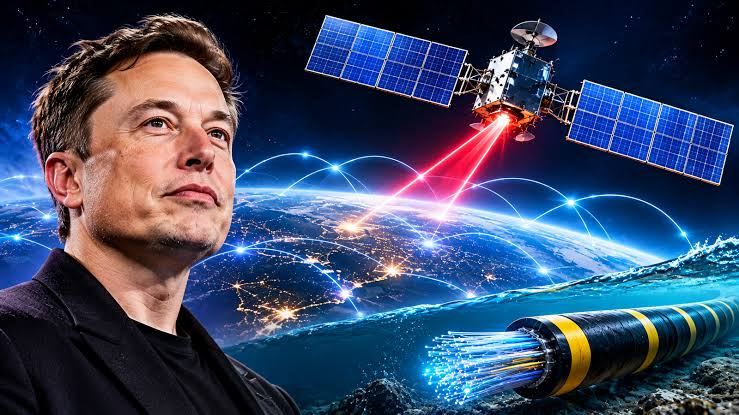
Elon Musk says a future Starlink constellation with about 100 lasers per satellite, each faster than 10 terabits per second, could outcompete the undersea cables that carry the world's intercontinental internet traffic. We checked each part of the claim against SpaceX's own figures, cable industry data and peer-reviewed research. The physics holds up. The capacity case does not yet.
On November 6, shortly after speaking at the Baron Investment Conference, Musk posted on X: "~100 lasers per satellite, each operating above 10 Tb/s, with over 100k satellites should be able to outcompete undersea cables. Speed of light in space is ~40% faster than cable and the path is direct, instead of following the outline of land masses." By Sunday the post had been viewed nearly 2.5 million times, according to X's public counts.
The claim matters because subsea cables are the backbone of the global internet, and SpaceX is the only company with a satellite network large enough to make the comparison sound plausible. It bundles three different assertions: one about physics, one about geometry, and one about future hardware and economics. They deserve different verdicts.
The verdict: mixed
Verdict: Mixed. The speed-of-light point is accurate, and if anything understated. The "direct path" point is largely right for long intercontinental routes, though not for short ones. The core claim, that the constellation "should be able to outcompete undersea cables," is unproven. It rests on laser speeds, laser counts and a constellation size that SpaceX has not built, specified in public or demonstrated. And the headline arithmetic it invites is not a like-for-like comparison with cable capacity.
Claim 1: light is about 40% faster in space than in cable
Accurate, slightly understated. Light in standard optical fiber travels through glass, which slows it to roughly two-thirds of its speed in a vacuum. Mark Handley, a networking researcher at University College London, put the gap plainly in a 2018 peer-reviewed paper on Starlink routing: the speed of light in a vacuum is about 47% higher than in optical fiber. Laser links between satellites travel through near-vacuum, so Musk's "~40%" is, if anything, conservative.
There is one caveat that rarely appears in this debate. The fiber industry is attacking the same gap. Hollow-core fiber guides light mostly through air rather than glass. Microsoft says its design carries signals about 47% faster than conventional fiber and has been deployed in parts of its Azure network, and a Microsoft and University of Southampton team reported record-low signal loss for the technology in 2025. Hollow-core fiber is not yet a standard subsea product. But the speed advantage Musk describes belongs to "light not in glass," not to satellites as such.
Claim 2: the path is direct
Largely accurate for long routes, misleading for short ones. Cables follow coastlines, avoid hazards and land at specific stations. A laser mesh in orbit can, in principle, route closer to the great-circle line between two cities. Handley's simulations found that a dense low-Earth-orbit constellation could beat the lowest latency physically possible over fiber for distances greater than about 3,000 kilometers.
The path is not literally direct, though. Traffic must climb several hundred kilometers to a satellite, hop between satellites whose positions are constantly changing, and descend again. Over short distances that detour costs more time than the faster medium saves, which is why the advantage only appears on long routes. Real latency also depends on routing, queuing and processing, not only on propagation speed. So the latency case for a laser mesh is real, but it is strongest for intercontinental, latency-sensitive traffic such as financial trading, not for the bulk of everyday internet use.
Claim 3: the network "should be able to outcompete undersea cables"
Unproven. This is the part of the claim with the most weight and the least evidence. Every number in it is a target.
How far the targets are from today's network
Start with what SpaceX has said publicly. In early 2024, SpaceX engineer Travis Brashears told the SPIE Photonics West conference that Starlink's roughly 9,000 laser terminals were moving more than 42 petabytes of customer data a day, with individual links sustaining about 100 gigabits per second. Averaged over a day, 42 petabytes works out to roughly 3.9 terabits per second, by our arithmetic. SpaceX's 2025 progress report says each V2 Mini satellite carries three laser links, the mesh has more than 24,000 lasers, and hardware upgrades would enable 400 gigabit-per-second operation.
Against that baseline, Musk's post implies:
- about 10 terabits per second per laser, roughly 100 times the 100 gigabits Musk himself cited for today's links, and 25 times the planned 400-gigabit upgrade;
- about 100 lasers per satellite, against three today;
- more than 100,000 satellites, against a little over 11,000 Starlink satellites in orbit as of November 7, according to tracking data compiled by astronomer Jonathan McDowell.
Musk's own statements do not agree on the laser count. In the conference clip, he said the next-generation links would run at 10 terabits per second and "we'll put 10 of them on," according to transcripts published by outlets that reviewed the video. When an X user multiplied that to 100 terabits per second per satellite, Musk replied: "If we shrink laser size, assuming 10X closer proximity, and have small gimbal angle for in-plane links, maybe we can get to 100 lasers/sat." That is a conditional engineering ambition, not a specification.
Nor has the generation before it entered service. SpaceX's third-generation satellites, which the company says are designed for more than a terabit per second of downlink each, first reached orbit on Starship's 14th flight on September 28. As of early October, the 26 satellites were still in checkout and orbit-raising, not serving customers. SpaceX has not published a V4 design, launch date or regulatory filing that matches the figures in Musk's post.
Why the big numbers don't compare
The tempting calculation is to multiply the targets: 100 lasers at 10 terabits per second on 100,000 satellites adds up to 100 exabits per second of laser terminal capacity. TeleGeography, the telecom research firm, puts total international internet bandwidth at 2,259 terabits per second, or about 2.3 petabits. On paper, that looks like no contest.
It isn't a fair comparison, for three reasons.
First, summed terminal speed is not network capacity. A link between two satellites uses a terminal at each end, so the figure double-counts. More importantly, a long-distance route crosses many satellites, and each hop consumes laser capacity along the way. As an illustration, a route that needed ten hops would tie up a laser terminal at each end of every hop, twenty terminals for one stream of traffic. A cable's capacity, by contrast, is the end-to-end figure.
Second, the traffic has to come down to Earth. Undersea cables land at stations wired straight into terrestrial networks. A satellite mesh must move every bit through radio or optical links to ground stations or user terminals, and much of the constellation is over ocean, desert or polar regions at any given moment. Those ground links, not the lasers in orbit, are likely to set the network's real throughput. That is our analysis, not a published SpaceX figure, but nothing in Musk's post addresses it.
Third, "outcompete" is an economic claim, and the post offers no cost figures. A single modern cable can carry a lot: TeleGeography cites the MAREA transatlantic cable at 224 terabits per second of potential capacity. The firm argues that "on a bit-for-bit basis, there's just no beating fiber-optic cables," and cites U.S. Federal Communications Commission statistics showing satellites accounted for just 0.37% of U.S. international capacity. Cables also last for decades on the seabed, while low-orbit satellites have to be replaced every few years. A 100,000-satellite network would need constant launches simply to stay the same size.
What would change the verdict
The verdict on the capacity claim would move toward accurate if SpaceX did any of the following: published a V4 satellite specification or regulatory filing confirming laser counts and speeds; demonstrated multi-terabit links between satellites in orbit, rather than in a lab; released measured end-to-end throughput for intercontinental routes; or began selling wholesale capacity at prices competitive with subsea routes. Any of those would give outsiders something to test.
The verdict would move toward inaccurate if V3 satellites, once in service, fell well short of their designed capacity, or if the laser upgrades SpaceX announced for 400-gigabit operation slipped significantly.
What remains unknown
Several things cannot be checked from public information: what laser speeds SpaceX has achieved in testing, how much ground-station capacity a 100,000-satellite network would need, what such a network would cost to build and replenish, and how its price per bit would compare with that of cables. It is also unclear what Musk means by "outcompete." Winning on latency for a few premium intercontinental routes is plausible within the physics described above. Carrying a meaningful share of the world's international traffic is a much larger claim, and nothing published so far supports it.
The bottom line
Musk is right about the physics, and the latency advantage of laser links in orbit over long distances is well established in research. But the claim that matters, that satellites can replace cables as the internet's backbone, depends on hardware that does not exist yet, numbers that shifted between a fireside chat and a follow-up post, and an economic comparison he did not make. SpaceX says its laser mesh has already cut latency by 30 to 40 milliseconds in parts of Asia and Africa, and that is a real achievement. Whether they can become a competitor for the bulk of intercontinental traffic, rather than a fast lane alongside the cables, is still an open question. The evidence that would settle it is a spec sheet SpaceX has not published. For more on another claim from the same conference, see our fact-check of Musk's space data center pitch.