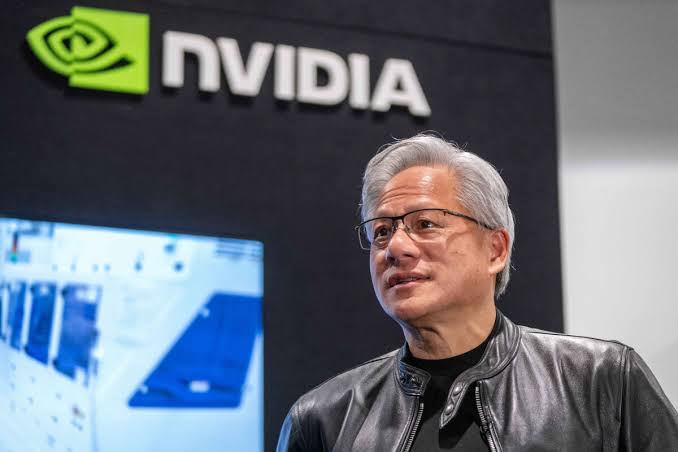
The unlikely rise of an industry-defining CEO
Jensen Huang was not born into the world of Silicon Valley wealth and influence. Born in Taiwan in 1963, he moved to the United States as a child. His early experiences included working as a dishwasher and waiter at Denny's, a job he later credited with teaching him humility, discipline and hard work.
He studied electrical engineering at Oregon State University before earning a master's degree in electrical engineering from Stanford University. Before becoming an entrepreneur, he worked at semiconductor companies LSI Logic and Advanced Micro Devices.
In 1993, at the age of 30, Huang co-founded Nvidia with Chris Malachowsky and Curtis Priem.
The company's original ambition was to build powerful graphics processors for personal computers. At the time, the market was largely concerned with making computer graphics faster and more realistic. Few could have anticipated that the technology would eventually become essential to artificial intelligence.
Nvidia's early journey was far from guaranteed. The company faced intense competition and difficult technological transitions. Its survival depended on recognizing that computing would increasingly require specialized processors rather than relying exclusively on traditional central processing units.
That decision would eventually change the direction of the technology industry.
The bet that changed everything
Nvidia's most consequential strategic decision was its investment in general-purpose GPU computing.
Graphics processing units, or GPUs, were originally designed to perform the parallel calculations required to render images. Unlike CPUs, which are optimized for handling a relatively small number of complex tasks, GPUs can execute enormous numbers of simpler calculations simultaneously.
This architecture turned out to be exceptionally useful for artificial intelligence.
In 2006, Nvidia introduced CUDA, a software platform that allowed developers to use its GPUs for general-purpose computing.
The significance of CUDA was difficult to appreciate at first. Nvidia was not simply selling faster chips. It was building an ecosystem of hardware, software, development tools and technical expertise that encouraged researchers and businesses to build around its technology.
As deep learning gained momentum during the 2010s, Nvidia's GPUs became increasingly important to training sophisticated neural networks.
When ChatGPT arrived in late 2022, the company was already positioned at the center of the infrastructure required to train and operate large AI models.
The AI boom did not create Nvidia's technological advantage overnight. It rewarded investments Huang had made years before the technology became commercially fashionable.
From chipmaker to the infrastructure of AI
The transformation of Nvidia has been extraordinary.
The company moved beyond graphics processors into networking, accelerated computing, AI software, robotics and complete data-center systems.
Its chips became essential infrastructure for companies developing large language models, generative AI products and increasingly sophisticated autonomous systems.
The commercial consequences were staggering.
In its second-quarter fiscal 2027 results, announced on August 26, 2026, Nvidia reported revenue of $96.2 billion, representing 106% growth compared with the same quarter a year earlier. Its data-center business generated $89 billion.
These figures illustrate how thoroughly the economics of the AI boom had become tied to Nvidia's products.
Huang also understood that the next phase of AI would require much more than training increasingly powerful models.
AI inference, the process through which trained models generate responses and perform tasks, was becoming a major commercial opportunity. Robotics, industrial automation, autonomous vehicles and scientific computing offered additional markets.
His argument was that AI was becoming a new form of industrial infrastructure.
In this vision, Nvidia would not merely supply the processors. It would provide the computing platform on which entire industries would operate.
The CEO who became the face of AI
Huang's influence extended beyond engineering and corporate strategy.
His trademark black leather jacket, energetic product presentations and ability to explain complex technological developments helped turn him into an unusually recognizable technology executive.
Unlike many semiconductor executives, Huang became a celebrity figure among investors, developers and politicians.
His relationships with major technology companies also gave him considerable influence over the direction of the AI industry.
Companies developing frontier AI models needed Nvidia's processors. Cloud providers needed them to build data centers. Governments wanted access to the computing capacity required to compete in artificial intelligence.
This made Huang more than the CEO of a successful semiconductor company. He became one of the most important intermediaries in the global competition for AI infrastructure.
However, his extraordinary influence also created a vulnerability: Nvidia's identity and strategic direction became unusually closely associated with one individual.
November 12: The sudden departure
On November 12, 2026, Nvidia announced that its board had accepted Huang's resignation as president and CEO, effective immediately. He also stepped down from the company's board.
The announcement followed several days of intense scrutiny.
Reports had raised questions about Huang's personal relationships, including an alleged relationship with a businesswoman whom US authorities reportedly suspected of having links to Chinese intelligence. Separate reporting also raised allegations involving an Nvidia employee.
Huang acknowledged infidelity in a message to employees, according to reporting by Reuters. Nvidia's board had been examining whether he had been targeted by a foreign intelligence operation.
These are distinct issues: the reported personal relationships, the national-security concerns and the question of whether any confidential company information was compromised. Allegations and investigations should not be treated as proof that Nvidia's technology or trade secrets were compromised.
Nevertheless, the developments created a serious governance crisis for a company whose chief executive had become closely identified with its success.
Nvidia appointed longtime chief financial officer Colette Kress as interim CEO while the board considers a permanent successor.
The transition is particularly significant because Huang had led Nvidia since its founding in 1993. Few major technology companies have had such a long-serving founder at the center of their strategic decision-making.
Can Nvidia succeed without Jensen Huang?
The immediate question is not whether Nvidia can continue manufacturing powerful AI processors. Its technological capabilities, engineering teams, customer relationships and software ecosystem extend well beyond its chief executive.
The harder question is whether the company can maintain its strategic coordination without the person who has directed it for more than three decades.
Huang operated with an unusually flat management structure, with dozens of executives reporting directly to him. His leadership style concentrated substantial strategic authority in his office.
That arrangement helped Nvidia move quickly across multiple technological markets. It also made succession planning particularly important.
Colette Kress brings considerable institutional knowledge. She has served as Nvidia's CFO since 2013 and understands its financial position, operations and commercial relationships.
But managing Nvidia's finances and leading its technological strategy are different responsibilities. The board must demonstrate that the company's leadership structure can function effectively without its founding CEO.
The transition also arrives at a sensitive moment. Competition in AI hardware is intensifying, major cloud companies are developing their own processors, and governments are increasingly treating advanced semiconductor technology as a national-security priority.
Nvidia's next leader will inherit an extraordinary business, but also a company facing challenges that extend well beyond quarterly earnings.
The legacy of Jensen Huang
Huang's legacy will ultimately be measured by more than the company's market valuation or the performance of its latest generation of processors.
His most important contribution may have been recognizing that the future of computing would look fundamentally different from its past.
While much of the industry focused on conventional processors and incremental improvements, Huang invested in parallel computing and the software ecosystem necessary to make it useful.
That long-term commitment positioned Nvidia to benefit from the rise of deep learning, generative AI and the growing demand for accelerated computing.
His departure does not erase those achievements, nor does it automatically end Nvidia's dominance.
But it exposes a question that the AI industry has rarely had to confront: how much of its success depends on the vision of a single person?
For more than 30 years, Huang was Nvidia's defining leader. He helped turn a graphics-chip company into the infrastructure provider of an emerging technological era.
Now the company must demonstrate that the institution he built is bigger than the individual who led it.
That may prove to be the most important test of his legacy.