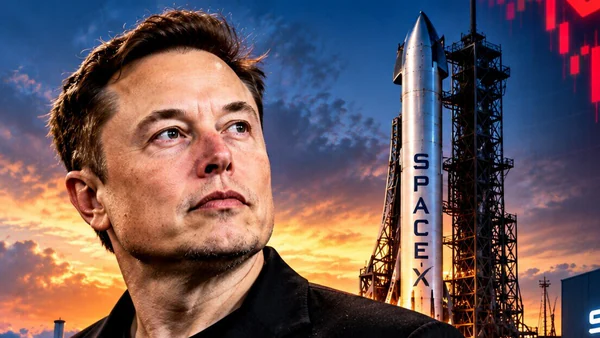
Elon Musk told investors on Friday that an Nvidia GPU and a Google TPU are "working fine in space." Both satellites are real, both rode SpaceX rockets, and both are reported operational. What they prove about orbital AI data centers is far narrower than the pitch they were cited to support.
Asked about data centers in space at the Baron Investment Conference in New York on November 6, the SpaceX chief executive pointed to two machines already in orbit. "So there's a satellite with an NVIDIA GPU up there that we launched, and there's a satellite we recently launched with a Google TPU," he said, according to InvestmentNews. "And these are operating to the best of my knowledge — they're working fine in space."
He offered the two satellites as early evidence for SpaceX's own plan, Starmind, which he said would begin launching orbital computers co-designed with Nvidia "probably" in the third quarter of 2027, then scale to "very, very large volume in '29." With data centers now a flashpoint after Tuesday's midterm elections and Thursday's market sell-off, the claim that the hardware already works in orbit carries weight. We checked it.
The verdict: accurate statement, misleading inference
Verdict: Mixed. The literal claim holds up. Both satellites exist, SpaceX rockets carried both to orbit, and the companies that operate them say they are working. But the two machines are small technology demonstrators. One carries a single GPU; the other carries four TPUs that, according to NPR's reporting, run in 15-minute bursts because of heat limits. They show that data-center chips can survive and compute in low Earth orbit. They do not show that orbital data centers work at a scale or price that matters, and the hardest parts of that case have not yet been tested.
Claim one: an Nvidia GPU satellite "that we launched"
Accurate, with a clarification. The satellite is Starcloud-1, built by the startup Starcloud, not by SpaceX. It launched on November 2, 2025, on SpaceX's Bandwagon-4 rideshare mission aboard a Falcon 9, carrying an Nvidia H100, according to IEEE Spectrum and Starcloud. The 60-kilogram spacecraft was the first to fly a data-center-class GPU; Nvidia's smaller Jetson boards had flown on satellites before.
"We launched" is fair in the sense that SpaceX was the launch provider. It is not a SpaceX-designed payload, and nothing in its performance tells us about SpaceX's own satellite design.
Is it "working fine"? Starcloud says so. On the first anniversary of launch this month, the company wrote that Starcloud-1 "is operating today with the only NVIDIA H100 in space," and it has previously said the satellite ran a version of Google's Gemini model and trained a small language model in orbit. Public orbital data from Space-Track and CelesTrak show the object still in a roughly 500-kilometer orbit. We found no independent telemetry confirming the GPU's workload, so "operational" rests on the operator's word, though nothing contradicts it.
Claim two: a Google TPU satellite "we recently launched"
Accurate. Google's Project Suncatcher prototype, built with Planet Labs, launched on October 1, 2026, on SpaceX's Transporter-18 rideshare, according to Google and Planet. On October 30, Google reported its "Hello World" milestone: an onboard Gemma 4 model generated a haiku that was downlinked over Svalbard, Norway, after the team powered up the TPU trays and ran early machine-learning tests.
That is the strongest evidence behind Musk's "working fine." It also comes with Google's own limits attached. The company says the next phase is testing "how TPUs perform under thermal stress and radiation exposure in orbit," which means the results that matter most for a data center are still pending. Project lead Travis Beals told NPR the satellite is "a very minimal test." NPR also corrected its launch-day report to note that this prototype is not in the sun-synchronous orbit planned for future satellites and relies on batteries.
One piece of context investors may want: CNBC reported that Alphabet holds a stake in SpaceX worth more than $82 billion. Neither company is a neutral narrator of space computing's prospects.
What the two satellites actually prove
Taken together, the demonstrations establish three things: modern AI accelerators can be launched, powered up and kept alive in low Earth orbit; they can run real model inference there; and, in Google's earlier ground tests, its Trillium TPU tolerated radiation doses well beyond a projected five-year mission before its high-bandwidth memory began showing irregularities, according to Google's November 2025 research post.
What they do not establish is the economics and physics of scale. Getting rid of heat is the clearest example. In space there is no air or water to carry heat away; it must be radiated from large panels. Google's prototype reportedly runs its model for 15 minutes at a time because of thermal limits. SpaceX's marketing says heat "radiates freely into the vacuum of space," which is true of the mechanism but silent on how much radiator area and mass it takes to shed hundreds of kilowatts continuously. Neither demonstrator tests that at data-center power levels.
The scale gap is large. An Nvidia H100 is rated at up to about 700 watts. SpaceX's Starmind page lists its first AI1 satellite at up to 250 kilowatts peak and 175 kilowatts average. By our arithmetic, a single 1-gigawatt AI campus, the scale of several announced terrestrial AI projects, would need roughly 5,700 AI1 satellites at that average power. Musk's stated ambition of "200 gigawatts per year" would mean on the order of a million such satellites a year. SpaceX has publicly discussed deploying "up to" 1 million orbital data-center satellites, as Light Reading reported.
The plan has also been moving. In August, Musk wrote on X that the first space-optimized Vera Rubin NVL72 system would launch in the fourth quarter of 2027; on Friday he said the third quarter, while adding "I'm just guessing here." Light Reading reported the AI1 spec in August as about 150 kilowatts peak and 120 kilowatts average; SpaceX's page now lists 250 and 175. Neither change is a contradiction on its own, but together they show this is a design still in flux, not a shipping product.
Checking the supporting claims
"You get 30% more solar power in space"
Roughly accurate, and understated. Sunlight above the atmosphere delivers about 1,361 watts per square meter, compared with the 1,000 watts per square meter used as the industry's standard test condition for panels on the ground. That is about 36% more at peak. The bigger advantage is time: in a dawn-dusk sun-synchronous orbit a panel sees near-constant light, and Google says a panel in the right orbit can be "up to 8 times more productive" than on Earth.
"You can get away with a very tiny battery pack"
True only in the right orbit. It holds for the dawn-dusk sun-synchronous orbit SpaceX and Google plan to use. It does not describe either demonstrator Musk cited: Google's prototype uses batteries, per NPR's correction, and public orbital data put Starcloud-1 at an inclination of about 45 degrees, not in a sun-synchronous orbit.
Starship will cut launch costs "by a factor of 100, or maybe more"
Unproven. This is a forecast. The economics of orbital computing hinge on it: Google's own analysis says launch prices would need to fall below about $200 per kilogram, which it projects for the mid-2030s, before the cost of launching and operating a space data center becomes "roughly comparable" to the energy costs of an equivalent ground facility. Starcloud's chief executive has put break-even nearer $500 per kilogram. Starship's upper stage has not yet been caught and reused; InvestmentNews reports SpaceX is targeting November 13 for its first attempt to catch the ship with the launch tower.
What would change the verdict
The "mixed" rating would move toward accurate if the operators publish sustained performance data, such as hours of continuous full-power compute, error rates under radiation and thermal behavior over months, or if Google's planned twin-satellite mission in 2027 shows data-center-grade links between satellites. It would move toward misleading if either demonstrator degrades or goes silent and the companies do not disclose why.
What remains unknown is the part that decides the business: the mass and cost of radiators at hundreds of kilowatts per satellite, how many chips fail over years in orbit and how they are replaced, what bandwidth reaches the ground, and whether reusable Starship flights hit the prices the models assume.
The bottom line
Musk described the hardware accurately: two AI satellites are in orbit, SpaceX carried both, and both are reported to be working. Used as evidence that space data centers are now viable, the claim goes beyond what the satellites can show. They prove that AI chips can run in orbit. Whether orbital computing can compete with ground data centers on power, heat and cost has not yet been tested, and that is the question investors and communities are now being asked to take on faith.