China's artificial intelligence ambitions are running into a familiar obstacle: access to advanced computing hardware.
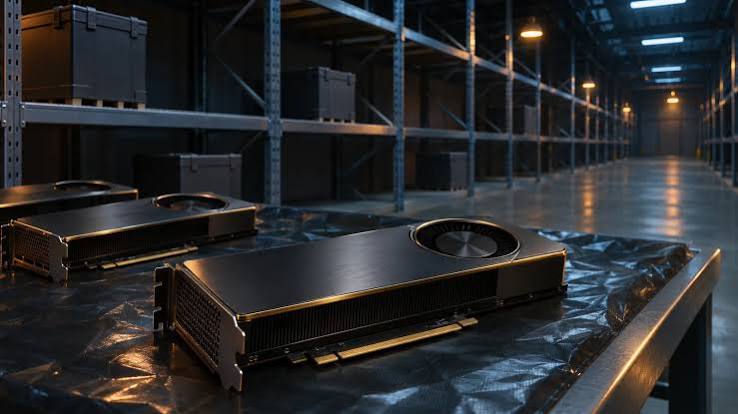
Some of the country's largest technology companies have collectively ordered approximately six million Nvidia RTX PRO 5500 chips, representing an estimated $70 billion in potential purchases. Yet they expect to receive only tens of thousands of units over the next four months, equivalent to roughly 1% of the quantity ordered.
The figures, reported by Bloomberg on November 4, 2026, highlight the growing imbalance between China's demand for artificial intelligence computing capacity and its ability to secure the hardware needed to support it.
Alibaba, Tencent, ByteDance and other Chinese AI and cloud computing companies are seeking Nvidia processors to expand their computing infrastructure as demand for AI services continues to increase. However, Nvidia's limited production capacity and its decision to prioritize more advanced, higher-margin products are creating a significant supply bottleneck.
The situation illustrates a central contradiction in China's technology ambitions. Despite substantial investment in domestic semiconductor development, some of its largest technology companies continue to depend heavily on American hardware to compete in the global artificial intelligence industry.
Why China Is Ordering Nvidia's RTX PRO 5500 Chips
The RTX PRO 5500 occupies an unusual position in the increasingly complicated US-China semiconductor relationship.
Washington has imposed restrictions on the export of Nvidia's most powerful AI processors to China, citing national security concerns and the potential military applications of advanced computing technology.
These restrictions have limited Chinese companies' access to some of the hardware used by American AI developers. Consequently, Chinese technology companies have increasingly searched for processors that remain commercially available while providing sufficient computing performance for their operations.
The RTX PRO 5500 has emerged as an attractive option.
Unlike Nvidia's most powerful data center accelerators, the RTX PRO 5500 is a professional workstation GPU. It is designed for demanding professional computing workloads, including graphics processing and AI-related applications. Although it is not a direct replacement for Nvidia's most advanced data center platforms, it offers capabilities that Chinese companies consider valuable for expanding AI inference capacity.
Inference refers to the process of running an already-trained AI model to generate responses, produce content or perform other tasks. As AI applications move from development into everyday commercial use, inference capacity is becoming increasingly important.
For Chinese technology companies, the RTX PRO 5500 therefore represents a practical alternative at a time when access to more powerful Nvidia processors remains restricted.
The reported orders also reveal how much demand exists for Nvidia hardware in China, even when the available products fall short of the performance offered by the company's leading AI accelerators.
Nvidia Has a Different Priority
The problem for Chinese buyers is not simply whether Nvidia is willing to sell them the chips. It is whether the company has sufficient production capacity to satisfy their orders.
Nvidia is facing enormous global demand for its AI computing products. Major technology companies and AI developers are investing heavily in data centers, creating competition for limited semiconductor manufacturing capacity.
Nvidia must also decide how to allocate the production resources available through its manufacturing partners.
Its priorities increasingly favor higher-margin products and its next-generation Rubin platform, which is designed to support large-scale AI computing infrastructure.
The company relies heavily on Taiwan Semiconductor Manufacturing Company (TSMC) to manufacture its advanced processors. Manufacturing capacity is finite, and production schedules must accommodate several product generations and competing customer requirements.
As a result, the RTX PRO 5500 is competing for manufacturing resources against products that offer Nvidia greater commercial returns.
This creates a difficult position for Chinese buyers. Even when a product is not prohibited under American export controls, that does not guarantee that sufficient quantities will be available.
Nvidia has warned customers about limited production capacity. A company spokesperson also declined to confirm the specific shipment estimates reported by Bloomberg.
The expected shortage therefore reflects both geopolitical restrictions and the commercial realities of semiconductor manufacturing.
The American Export-Control Strategy Is Reshaping China's AI Industry
Washington's semiconductor restrictions are intended to slow China's access to the most advanced computing technologies.
The underlying concern is that advanced AI processors can support applications extending beyond commercial services, including military research, intelligence analysis and sophisticated technological development.
By restricting access to the most powerful American chips, the United States hopes to preserve its technological advantage and make it more difficult for Chinese companies to develop and operate advanced AI systems at scale.
However, the consequences extend beyond the immediate availability of Nvidia processors.
Restrictions have encouraged Beijing to accelerate its efforts to develop an independent semiconductor ecosystem. Chinese companies have been investing in domestic processors, manufacturing capabilities and alternative computing architectures.
The strategy is not new. China has spent years attempting to reduce its dependence on foreign semiconductor technology, recognizing that access to advanced chips is a strategic vulnerability.
Yet developing competitive processors requires more than designing a chip. It involves sophisticated manufacturing equipment, advanced semiconductor fabrication, high-bandwidth memory, packaging technologies and a wider ecosystem of suppliers.
These are areas in which American and allied companies retain significant advantages.
The Nvidia shortage demonstrates that China's domestic semiconductor industry has made progress but has not yet eliminated the technological and manufacturing constraints facing its AI ambitions.
Huawei and China's Domestic Chipmakers Could Benefit
The most immediate beneficiaries of Nvidia's supply shortage could be Chinese semiconductor companies.
Huawei has become one of the most important players in China's effort to build domestic AI computing infrastructure. Its Ascend processor family is intended to provide an alternative to Nvidia hardware, particularly for Chinese technology companies seeking to reduce their exposure to American export restrictions.
Other domestic players, including Cambricon Technologies and Alibaba's T-Head semiconductor division, are also competing for a larger share of the market.
For these companies, Nvidia's inability to satisfy Chinese demand creates an opportunity that would otherwise be difficult to secure.
If Alibaba, Tencent and ByteDance cannot obtain the quantities of Nvidia processors they need, they have stronger incentives to evaluate domestic alternatives, invest in compatible software ecosystems and develop computing infrastructure around Chinese hardware.
However, capturing that opportunity will not be straightforward.
Nvidia's advantage is not limited to the performance of its processors. Its CUDA software ecosystem, developer tools and established hardware infrastructure make its products particularly attractive to AI developers.
Companies switching to domestic alternatives must consider compatibility, software optimization, performance, reliability and the cost of rebuilding existing systems.
Consequently, a shortage of Nvidia chips does not automatically translate into an equivalent increase in demand for Huawei or other domestic processors.
Nevertheless, the commercial incentives for adopting Chinese hardware are becoming stronger.
The Bigger Problem: China Needs Computing Capacity, Not Just Chips
The shortage also exposes a broader challenge facing China's AI industry.
Building competitive AI systems requires access to sufficient computing power. This involves not only processors but also electricity, data centers, networking equipment, memory and the infrastructure needed to connect thousands of computing units.
Even if Chinese manufacturers increase domestic chip production, they must still overcome constraints across the wider supply chain.
The challenge is particularly significant as AI companies increasingly compete over the cost and availability of inference computing.
The more widely AI applications are adopted, the greater the demand for computing resources required to operate them. Companies that cannot secure sufficient hardware may face higher operating costs, slower expansion or limitations on the services they can offer.
This is particularly relevant for Alibaba, Tencent and ByteDance, whose businesses span cloud computing, social media, e-commerce and consumer-facing AI applications.
Access to computing infrastructure is therefore not simply a procurement issue. It is becoming a strategic factor in determining which companies can expand their AI businesses most aggressively.
A Supply Shortage With Geopolitical Consequences
The reported $70 billion in orders should not be interpreted as $70 billion in confirmed Nvidia revenue. It represents the estimated value of requested chips, based on the reported quantities and prices. Actual deliveries, final orders and commercial transactions may differ.
Nevertheless, the scale of the demand is revealing.
China remains one of the world's largest technology markets, and its leading companies are willing to spend enormous amounts to secure access to Nvidia hardware despite years of American export restrictions.
For Washington, this reinforces the importance of semiconductor controls. For Beijing, it demonstrates the urgency of building a domestic alternative capable of supporting the country's AI ambitions without relying on American suppliers.
For Nvidia, the situation presents a commercial dilemma. China represents a substantial potential market, but the company's manufacturing capacity and product priorities are increasingly shaped by demand from customers building the world's largest AI infrastructure projects.
Ultimately, the shortage reveals that the competition between the United States and China is not simply about which country can develop the most advanced artificial intelligence models.
It is also about who controls the hardware, manufacturing capabilities and computing infrastructure that make those models possible.
China may have the financial resources and technological ambition to compete with American AI companies. But until its domestic semiconductor industry can deliver computing capacity at the necessary scale and performance, access to foreign hardware will remain an important vulnerability.
The next phase of the AI competition may therefore be determined as much by semiconductor manufacturing capacity as by breakthroughs in artificial intelligence itself.