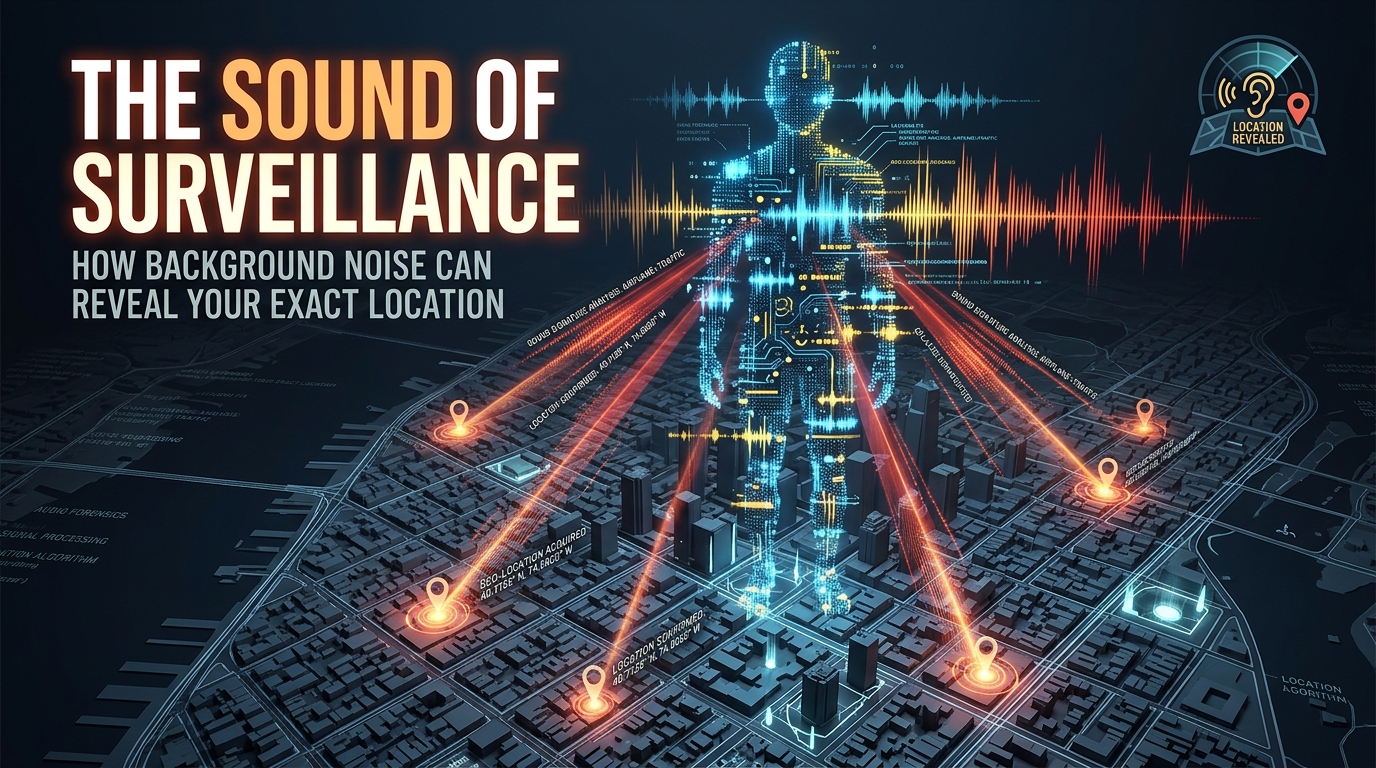
A video does not need to show a street sign, a recognizable building or even a person's face to reveal where it was recorded. Sometimes, the most revealing information is hidden in the soundtrack.
A demonstration published by an independent researcher known as Colsto on November 2, 2026, has highlighted an unusual privacy risk: the faint sound of aircraft passing overhead can potentially reveal the location of a recording, even when the aircraft are barely perceptible to human listeners.
The technique combines audio signal processing, aircraft movement data and a fundamental principle of physics known as the Doppler effect. In the demonstration, the researcher used background aircraft sounds to narrow down a recording's location to approximately 100 meters.
More remarkably, the investigation reportedly succeeded using a recording of approximately one minute.
The discovery raises an important question for the digital age: how much information are people unintentionally revealing whenever they record and share audio or video?
How can the sound of an airplane reveal your location?
The underlying principle is the Doppler effect, the change in the observed frequency of a sound as its source moves relative to an observer.
It is the same phenomenon responsible for the familiar change in pitch when an ambulance approaches and then drives away. As the vehicle approaches, its siren sounds higher in pitch. Once it passes, the pitch drops.
Aircraft produce a similar acoustic signature.
Even when an airplane is too distant to be clearly heard, its sound can leave measurable patterns in a recording. Sophisticated audio analysis can identify these patterns and estimate how the aircraft was moving relative to the microphone.
The researcher then connected those measurements to publicly available ADS-B flight-tracking data, which contains information about aircraft positions, altitude, speed and movement.
By comparing the predicted sound of aircraft at different possible recording locations against the actual audio, it becomes possible to eliminate locations that do not match.
In other words, the recording becomes a source of geographical evidence.
Turning public flight data into a surveillance tool
The particularly interesting part of this demonstration is that it does not depend on hacking a smartphone, accessing GPS information or compromising a recording device.
ADS-B data is transmitted by aircraft and can be collected through publicly accessible flight-tracking services.
The researcher combined this information with mathematical models of aircraft movement, sound propagation and terrain elevation.
Two separate aircraft flyovers provided additional evidence. Their acoustic signatures, combined with the time separating the events, helped narrow the possible recording locations.
The investigation also reportedly tested the technique against a separate one-minute recording, searching across the United States and successfully ranking the actual location first.
This illustrates an important distinction in cybersecurity: information does not always need to be secret to become dangerous. Individually harmless public datasets can reveal sensitive information when combined with other data.
Why conventional privacy protections may not be enough
One of the more concerning aspects of the demonstration is that common audio-processing techniques may not reliably eliminate the information.
The researcher examined whether high-pass filtering, adding background noise and the compression used in telephone calls could prevent the analysis.
These approaches did not necessarily remove the relevant acoustic patterns.
This matters because people often assume that removing identifiable visual details, muting obvious background conversations or compressing a recording makes it safer to share.
But audio contains more information than speech. It also captures the acoustic environment in which a recording was made.
A recording can therefore retain geographical clues even when its most obvious identifying features have been removed.
This is not the first time sound has exposed location
The broader security concern has a history.
In 2018, researchers presented a study titled I'm Listening to Your Location! Inferring User Location with Acoustic Side Channels at the World Wide Web Conference.
That research examined electrical network frequency signals embedded in recordings. These signals can provide geographical and temporal clues because electricity networks have identifiable frequency characteristics.
The researchers demonstrated that recordings could be compared against reference signals to infer where they originated, without installing software on the recording device.
Their experiments reported 76% accuracy at the intra-grid level for recordings lasting at least five minutes.
DOI
A separate 2025 study explored how faint sounds generated by smartphone electronic components could correlate with wireless signal strength and help estimate location. Its reported accuracy was considerably less precise, averaging approximately four kilometres.
MDPI+1
These studies demonstrate that acoustic information can become an unexpected source of location intelligence. The new aircraft demonstration takes a different approach, using external aircraft movements rather than electrical or smartphone-generated sounds.
Does this mean every video can reveal your exact location?
Not necessarily.
The demonstration should not be interpreted as proof that every recording can be geolocated to within 100 meters.
The technique depends on several conditions, including:
Access to sufficiently accurate recording timestamps.
Aircraft passing close enough for their acoustic signatures to be detected.
Flight-tracking information covering the relevant aircraft.
Audio quality sufficient to extract the Doppler patterns.
Enough candidate locations and computing resources to perform the comparison.
The approximately 100-meter result is a demonstrated outcome under particular conditions, not a universal accuracy guarantee.
There is also an important geographical limitation: the demonstration used publicly available aircraft tracking data and tested its methodology across the United States. Its performance in regions with less comprehensive flight-tracking coverage remains an open question.
Nevertheless, the underlying principle is not restricted to one country.
What does this mean for ordinary internet users?
The implications extend beyond people posting videos on social media.
Journalists, activists, businesses, content creators and individuals sharing recordings from sensitive locations could unintentionally expose information about where they operate.
For example, a video recorded inside an otherwise unidentifiable building might contain aircraft sounds that help an investigator narrow down its geographical location.
The same concern applies to security camera recordings, voice recordings and other media files shared online.
The important lesson is that privacy cannot be evaluated solely by looking at what a recording visibly contains.
Its background information can be just as revealing.
How can people reduce the risk?
There is no universal solution that guarantees protection against every form of acoustic geolocation. However, users can reduce unnecessary exposure.
Avoid publishing original recordings: Consider whether a recording needs to be shared in its original form.
Review audio before publication: Background sounds can reveal more than expected.
Limit recording metadata: Remove unnecessary location and device metadata when sharing files.
Be careful with sensitive recordings: Avoid publicly distributing unprocessed recordings made in locations where anonymity matters.
Treat audio as sensitive information: Muting speech does not necessarily eliminate environmental clues.
Importantly, simply removing GPS metadata does not eliminate acoustic location information. These are different sources of evidence.
The bigger cybersecurity lesson: Privacy is becoming harder to define
The most significant aspect of this demonstration is not that aircraft can be heard in recordings. It is that seemingly insignificant information can become powerful when combined with other publicly available data.
For years, digital privacy discussions have focused on GPS tracking, cookies, location permissions, IP addresses and smartphone applications.
But this research highlights another dimension: the physical environment itself can leave a digital fingerprint.
The recording does not need to announce where it was made. It only needs to preserve enough information for someone with the right data and analytical tools to reconstruct the answer.
As open-source intelligence techniques become more sophisticated, the boundary between publicly available information and genuinely private information becomes increasingly difficult to maintain.
The next privacy risk may not come from what your phone knows about you. It may come from what the world around you unintentionally reveals.