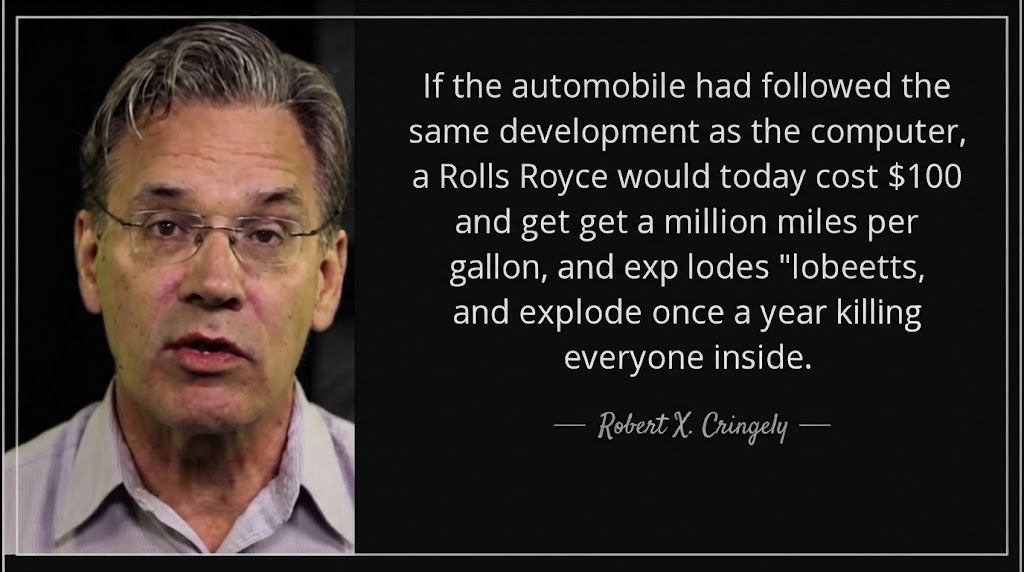
Mark Stephens, the technology journalist better known by his pen name Robert X. Cringely, died on October 3, 2026, at the age of 73. For readers who followed the personal-computer revolution from the 1980s onward, Cringely was more than a technology reporter. He became one of the distinctive chroniclers of Silicon Valley itself: its ambitious founders, eccentric engineers, ruthless competition, enormous fortunes and occasional absurdity.
His importance is particularly interesting now because the technology industry is once again living through a period in which enormous amounts of money are chasing a technology that promises to reshape the economy. Cringely spent much of his career examining what happened when personal computers, software and the internet moved from being hobbies and specialist tools into enormous industries. His observations were rarely just about the machines. They were about the people and incentives behind them.
That makes his work relevant to the artificial-intelligence boom, even though he did not live to see where the current AI cycle ultimately leads. The lesson is not that Cringely predicted today's AI boom or that he specifically warned about an AI bubble. It is that he understood something that remains remarkably consistent across technology revolutions: the technology may be new, but the human behavior surrounding it often isn't.
The Man Behind the Name
Cringely was the pseudonym of Mark Stephens, who became widely known through his long-running technology writing, particularly his work for InfoWorld. His persona was deliberately irreverent. He could write about billion-dollar companies and important technological developments while also focusing on the personalities, rivalries and strange behavior that shaped Silicon Valley.
That combination helped distinguish him from conventional business journalism. Silicon Valley was often presented as a place of brilliant inventions and inevitable progress. Cringely was more interested in the messy reality behind that mythology: who made the decisions, who received the money, who lost control and which companies were simply in the right place at the right time.
His 1992 book Accidental Empires became one of the defining accounts of the early personal-computer industry. Rather than treating the history of technology as a clean sequence of breakthroughs, Cringely examined the personalities and competitive battles that produced companies such as Apple and Microsoft. The book later became the foundation for his best-known television work.
When Silicon Valley Was Still Becoming Silicon Valley
In 1996, PBS aired Triumph of the Nerds: The Rise of Accidental Empires, a three-part documentary hosted and written by Cringely. The series examined the birth and growth of the personal-computer industry and featured interviews with some of its most important figures, including Bill Gates, Paul Allen and Steve Jobs.
What made the documentary memorable was not simply the list of famous people. Cringely treated the history of computing as a human story. The garages, offices and early companies mattered, but so did ego, rivalry, timing, mistakes and luck. The people who eventually became icons were presented as participants in a chaotic industry rather than as inevitable winners whose success had been predetermined.
That perspective remains useful because modern technology companies are increasingly being described in similarly heroic terms. Artificial intelligence has produced its own collection of famous founders, engineers and executives, while companies compete to control chips, models, cloud infrastructure and distribution. The scale is different, but the underlying competition is familiar.
The Steve Jobs Interview
Among Cringely's most remembered pieces of work was his 1995 interview with Steve Jobs, conducted when Jobs was running NeXT and several years before his return to Apple transformed the company.
The interview was originally conducted for Triumph of the Nerds. Years later, the full recording was released as Steve Jobs: The Lost Interview, giving audiences a much longer and more revealing look at Jobs than the excerpts that had previously circulated.
It became another example of Cringely's approach to technology journalism. He was not simply interested in asking what a product did. He wanted to understand the person making the product and the competitive environment surrounding the company. That approach gave his reporting a shelf life that many technology stories lack.
Why His Work Matters in the AI Era
The technology industry of 2026 looks very different from the Silicon Valley Cringely documented in the 1980s and 1990s. Today's companies are building enormous data centers, training increasingly powerful AI models and committing hundreds of billions of dollars to computing infrastructure. Nvidia has become one of the most valuable companies in history, while Microsoft, Google, Meta, Amazon, OpenAI and Anthropic are engaged in a competition over who will control the next generation of computing.
Yet the central questions are surprisingly familiar.
Who controls the critical technology? Who has enough capital to survive the next stage of the competition? Which companies are genuinely creating durable businesses, and which are benefiting mainly from investor enthusiasm? How much of a technological revolution is driven by the technology itself, and how much by the financial and competitive system built around it?
Those are precisely the kinds of questions that made Cringely's work valuable. He understood that technological revolutions do not happen in laboratories alone. They happen when inventions collide with money, personalities, corporate strategy and competition.
Technology Can Be Real and Still Become a Bubble
There is another lesson from the history Cringely chronicled that is particularly relevant to today's AI debate: a technology does not have to be fake for the investment surrounding it to become excessive.
The personal computer transformed society. The internet transformed communication and commerce. Yet both revolutions produced periods when investors dramatically overestimated individual companies, business models or the speed at which technological adoption would translate into profits.
Artificial intelligence may ultimately prove equally transformative. That does not automatically mean every company building an AI model, every data center being financed or every dollar being invested in AI infrastructure will generate an adequate return.
This distinction is important because the phrase "AI bubble" can be misleading. It can imply that the technology itself is a fraud. The more interesting question is whether the amount of money flowing into the industry has begun to outrun the revenues that the industry can realistically generate.
That is a question Cringely would probably have recognized immediately: not simply whether the technology works, but who is making money from it, who is financing it and who is taking the risk.
From Accidental Empires to AI Empires
Cringely's phrase "accidental empires" has acquired an almost prophetic quality in the current technology landscape. The companies dominating AI today did not all begin with the explicit intention of becoming infrastructure empires. Many evolved through a combination of technological breakthroughs, strategic decisions, acquisitions, enormous investment and favorable timing.
Nvidia is perhaps the clearest example. It began as a graphics-chip company and became central to the AI computing revolution because its GPUs turned out to be extraordinarily useful for training and running neural networks. Microsoft transformed itself through its partnership with OpenAI and its enormous cloud infrastructure. Google, Amazon and Meta have each committed huge resources to building their own AI capabilities.
The winners of the next technology cycle may already be visible. But history suggests that today's obvious winners are not necessarily guaranteed to remain dominant. IBM once appeared almost unassailable. Microsoft dominated the personal-computer era. Apple nearly disappeared before returning to become one of the world's most valuable companies.
Cringely's great strength was understanding that technological history is rarely a straight line.
The Journalist Who Followed the People Behind the Machines
Perhaps the most enduring part of Cringely's legacy is his decision to make technology journalism about people.
He wrote about computers, but his stories were really about ambition, rivalry, money, personalities and power. PBS described Triumph of the Nerds as an examination not only of the personal-computer industry's growth but also of the culture that produced it and the culture that it subsequently created.
That approach matters even more today because technology has become deeply embedded in almost every part of the economy. The companies building AI systems are no longer niche technology firms. Their decisions affect energy markets, financial markets, national security, employment and the future of the internet itself.
The temptation is therefore to focus entirely on the technology: how many parameters a model has, how fast a chip is, how large a data center is or how capable an AI agent has become. But Cringely's work offers another way of looking at the industry. Ask who is building it, who is funding it, who benefits from it and what happens when the assumptions behind the boom turn out to be wrong.
His Warning Was Less About Technology Than Human Nature
It would be too neat to claim that Cringely left behind a specific warning about today's AI boom. He did not write a final manifesto about artificial intelligence. His relevance comes from something more fundamental.
He understood that every technology revolution creates its own mythology. The pioneers become heroes, companies become empires and investors begin to believe that the future will arrive faster than anyone expects. Sometimes those expectations are justified. Sometimes they are not. Usually, the reality is somewhere between the two.
That is why his work remains useful as Silicon Valley enters another extraordinary period. The machines have become vastly more powerful since the era of the personal computer, but the incentives surrounding them have not changed nearly as much.
Technology still attracts dreamers. Money still follows excitement. Companies still fight for control of emerging markets. Founders still become celebrities. Investors still fear missing the next great opportunity. And when the cycle turns, the industry still discovers that technological progress and financial success are two different things.
Robert X. Cringely spent his career documenting that human drama.
Now, as the AI industry attempts to build its own generation of technological empires, his old work provides a useful reminder: the most important story in a technology revolution is often not the machine. It is what people do with it—and what they are willing to believe about it.