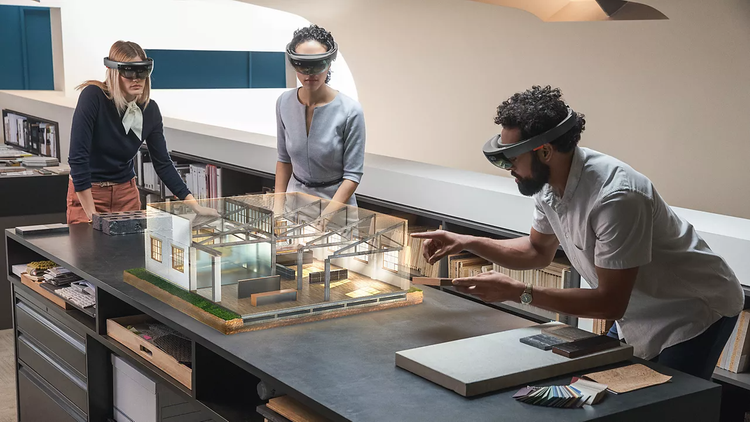
For several years, mixed reality seemed to be one of technology's great unfinished promises. The demonstrations were spectacular. Put on a headset and a digital dinosaur could appear in your living room. A giant cinema screen could float in front of you. A virtual monitor could stretch across an entire wall. Objects could be placed on a real table and manipulated with your hands. The technology could make the physical world appear to merge with the digital one.
And then consumers went home.
The problem was not that the technology failed to impress. It was that impressive demonstrations did not automatically translate into something people wanted to wear every day.
That distinction has shaped the next phase of the industry. Mixed reality is not disappearing, but the idea of what it is supposed to become is changing. The industry is moving away from the fantasy that everyone will spend their lives inside a virtual world and toward something considerably more practical: computers that understand the space around us and place digital information directly into it.
The hardware is changing too. IDC says the broader XR market is increasingly being driven by smart glasses rather than traditional headsets. In the first quarter of 2026, display-less smart-glasses shipments jumped 167% year over year to about 2.25 million units, while eyewear with displays grew 86%. IDC expects display-less smart-glasses shipments to reach 13.6 million units for the full year and 27.3 million by 2030.
That may be the most important development in mixed reality since the category began.
The future may not be about putting a computer on your face.
It may be about making glasses into the computer.
The metaverse was the wrong destination
Much of the early excitement surrounding virtual and mixed reality was built around the idea of the metaverse: persistent virtual worlds where people could work, socialize, play games and attend events through avatars.
The concept captured the imagination of the technology industry. Billions of dollars were invested. Companies changed their names. Executives began talking about virtual worlds as though the transition from smartphones to headsets was inevitable.
But consumers did not cooperate.
The fundamental problem was simple. People already had computers, phones and televisions that worked extremely well. Asking them to put a heavy headset on their face required a sufficiently compelling reason.
Gaming provided one.
Entertainment provided another.
But neither was enough to make a headset as universal as a smartphone.
The lesson has gradually become clear: mixed reality does not need to replace the physical world to be useful. It needs to make the physical world more useful.
That is a much smaller promise, but potentially a much more important one.
Apple changed the conversation
Apple's Vision Pro was an attempt to demonstrate what spatial computing could look like when hardware, software and industrial design were treated as one system.
The headset was expensive and deliberately positioned as a premium spatial-computing platform rather than a conventional gaming device. Yet the technology demonstrated something important: a computer could understand the user's surroundings, track their eyes and hands, and place digital windows and objects within physical space.
Apple has continued expanding that idea in visionOS. Its latest platform includes improvements to RealityKit, object tracking, spatial content creation and immersive media. Apple has also introduced Spatial Preview, allowing developers to preview and modify 3D content from a Mac on Vision Pro, and Foveated Streaming, which allows Mac and PC experiences to be streamed to the headset using eye-tracked rendering techniques.
These features may sound like developer details, but they reveal where the technology is heading.
The headset is becoming less of an isolated entertainment device and more of a window into a new computing environment.
A designer can examine a three-dimensional object.
An architect can walk around a building before it exists.
A developer can manipulate a spatial scene.
A professional can turn a conventional computer into an enormous private workspace.
That is a very different proposition from simply watching a virtual movie.
The real breakthrough may be happening outside VR
The most interesting part of the market may actually be the devices that do not look like VR headsets.
Meta's partnership with Ray-Ban helped demonstrate that consumers are much more willing to wear technology when it looks like something they already understand.
The first generation of smart glasses did not need to place a virtual world over your entire field of vision. They could simply add cameras, microphones, speakers and an AI assistant to something that looked like ordinary eyewear.
That lowered the psychological barrier.
People do not have to think of themselves as entering virtual reality.
They are simply wearing glasses.
IDC's 2026 data suggests that this distinction matters. Meta accounted for 69.2% of the global smart-glasses market in the first quarter, according to IDC, largely through its Ray-Ban partnership.
The significance goes beyond market share.
Meta demonstrated that the first successful consumer version of spatial computing might not begin with a fully immersive display.
It might begin with something much simpler: a camera, a microphone and an AI assistant sitting on your face.
AI could finally give mixed reality a reason to exist
This is where artificial intelligence changes the equation.
The first generation of augmented-reality products largely asked users to interact with digital information.
The next generation can potentially understand the user and their surroundings.
Imagine walking through a foreign city while your glasses identify a building and quietly explain its history. Imagine looking at a machine in a factory and receiving instructions without reaching for a manual. Imagine sitting in a meeting and having the system identify speakers, summarize the discussion and surface relevant documents.
The difference is subtle but profound.
The computer is no longer simply displaying information.
It is interpreting the environment.
That makes spatial computing much more interesting.
A phone knows where it is.
A mixed-reality device can potentially know what is around you.
The combination of computer vision, spatial mapping, speech recognition and generative AI could therefore turn the physical environment into a new interface.
The office may be one of the biggest opportunities
The consumer market gets most of the attention, but businesses may be where mixed reality becomes economically important first.
Consider product design.
A company developing a new vehicle can examine a digital model at full scale before manufacturing a physical prototype. Engineers can inspect components from different angles, collaborate around the same virtual object and identify design problems earlier.
The same concept applies to architecture, manufacturing, medicine, education and industrial training.
Fast Company recently highlighted digital twins and spatial computing as areas where immersive technology is becoming increasingly useful for product designers, museums and medical professionals.
The economics can be compelling.
A headset that costs thousands of dollars may sound expensive to an ordinary consumer.
But if that headset allows an engineering company to eliminate several physical prototypes, reduce travel or detect an expensive design error before manufacturing, the calculation changes completely.
That is why enterprise mixed reality may survive even if the consumer metaverse never becomes mainstream.
Businesses do not need technology to be fashionable.
They need it to save money or make something possible that was previously difficult.
The headset still has a problem
There is, however, a reason the industry is moving toward glasses.
People do not particularly enjoy wearing computers on their faces.
Headsets are heavy. They can be uncomfortable. They isolate users from other people. Batteries run down. They can cause eye strain or motion discomfort. They are also socially awkward.
The technology has improved enormously, but physics remains physics.
A headset capable of delivering high-resolution displays, cameras, sensors, processors and spatial tracking requires hardware. Shrinking everything into ordinary glasses while maintaining battery life and computing performance is an extraordinarily difficult engineering problem.
That is why the industry is likely to split into different categories.
High-end headsets will remain useful for professional applications, immersive entertainment, gaming and specialized work.
Lighter glasses will handle everyday information, communication and AI.
And some devices will sit somewhere between the two.
IDC expects the mixed-reality headset category itself to grow from about 3.2 million units in 2026 to 10.4 million by 2030, while optical see-through display glasses are forecast to grow from 3 million units to 12.2 million over the same period.
The market is therefore not disappearing.
It is fragmenting.
Meta and Apple are pursuing different futures
Apple's approach is built around spatial computing: a high-end computer that happens to be worn on the face.
Meta's strategy is broader. It is pursuing both immersive headsets and increasingly lightweight glasses.
The companies are effectively testing two different propositions.
Apple is asking:
What if the computer becomes a spatial environment?
Meta is increasingly asking:
What if computing disappears into something you already wear?
The second question may ultimately prove more important for mass adoption.
Nobody wants to think about "putting on a computer" before leaving the house.
People might be perfectly happy to put on their glasses.
That distinction could determine the future of the category.
The next interface may not have a screen
For decades, computing has followed a remarkably consistent pattern.
First came keyboards.
Then mice.
Then touchscreens.
Now we have voice assistants, cameras, gestures and increasingly AI-driven interfaces.
Mixed reality adds another possibility: the environment itself becomes the interface.
Instead of opening an application, you could look at something.
Instead of typing a command, you could speak.
Instead of navigating menus, you could manipulate a three-dimensional object.
Instead of looking at a map, you could see directions positioned in the street ahead.
The technology is moving toward a world where digital information is no longer confined to rectangular screens.
That does not mean screens disappear.
It means the screen becomes less important.
The privacy problem will be enormous
There is another reason the transition to everyday mixed reality will be difficult.
A smartphone camera points outward when you use it.
Smart glasses can potentially record continuously.
That creates an entirely different privacy problem.
Imagine entering a restaurant wearing glasses that can recognize faces, listen to conversations and analyze the environment. Imagine an AI system that can identify products, read documents and interpret what is happening around you.
The technology may be extraordinarily useful.
It may also make people uncomfortable.
The industry therefore faces a challenge that is not purely technical.
It has to establish social rules around machines that can see and hear almost everything their wearer can.
That may ultimately be more important than display resolution.
Mixed reality is becoming less about reality
There is an irony in the evolution of the industry.
The phrase "mixed reality" suggests that the objective is to mix virtual and physical worlds.
But the deeper transformation may be something else.
The goal is to make computers understand the physical world.
Once a machine can recognize objects, understand rooms, interpret conversations and remember context, it no longer needs to display a giant virtual environment to be useful.
A pair of glasses could quietly provide information without demanding your attention.
AI could become the invisible layer connecting the physical world to the internet.
That is a much more subtle future than the metaverse promised.
It is also potentially much more realistic.
The industry learned the wrong lesson from the metaverse
The failure of the metaverse hype does not mean spatial computing failed.
It may mean the industry aimed too far ahead.
Consumers did not want to abandon reality.
They wanted technology that made reality easier.
That is a crucial distinction.
The next generation of mixed reality will probably not ask people to spend their lives inside virtual worlds. It will attempt to make digital information available exactly when and where it is useful.
A mechanic may see instructions beside an engine.
A surgeon may examine a three-dimensional model.
A student may explore an ancient city.
An architect may walk through an unfinished building.
A remote worker may turn a small desk into a giant virtual workspace.
A traveler may see information about a building without taking out a phone.
The technology becomes valuable precisely because the user does not have to leave reality.
The strange future of computing
For decades, the computer has demanded our attention.
We sit in front of it.
We look down at it.
We open applications.
We type.
We scroll.
Mixed reality reverses that relationship.
Instead of forcing people to enter the computer, it attempts to bring the computer into the world around them.
That is why the current generation of devices matters even if none of today's headsets becomes the next iPhone.
They are prototypes for a different computing paradigm.
The biggest winner may not ultimately be Apple, Meta, Google or any individual hardware company. It may be the company that figures out how to make spatial computing so natural that people stop thinking of it as a category at all.
The best mixed-reality device may eventually be the one nobody calls a mixed-reality device.
It will simply be a pair of glasses.
You will put them on in the morning, walk outside and forget that there is a computer sitting on your face.
And that may be the real beginning of spatial computing.
Not when virtual reality becomes indistinguishable from reality, but when computing becomes indistinguishable from everyday life.