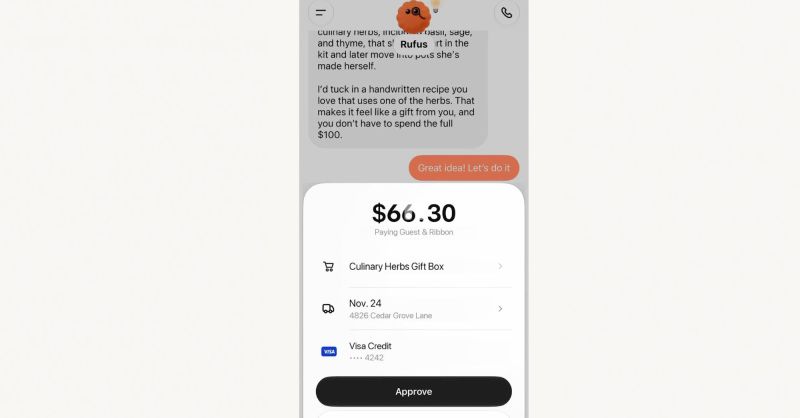
OpenAI's new ChatGPT Wallet lets its "dots" agents check out for you with a stand-in card number and a Face ID tap. The card security is strong. The fine print is the bigger story: your approval screen defines what you agreed to buy, and OpenAI disclaims liability for the rest.
Updated November 13, 2026, 12:20 p.m. New York time (EST)
OpenAI on Friday began rolling out ChatGPT Wallet, a payment feature that lets its personal AI agents, which it calls dots, complete purchases on a user's behalf. It was built with American Express, Mastercard and Visa, and at launch it is limited to ChatGPT Pro subscribers in the U.S. who are 18 or older and hold an eligible U.S.-issued American Express, Chase, Mastercard or Visa card, according to OpenAI's announcement and its help center.
Most coverage has focused on the security design: the agent never sees your real card number, and every purchase needs a biometric check. That part is real. But the documents OpenAI published alongside the launch, especially the ChatGPT Wallet Terms that took effect on November 12, answer a more practical question for anyone thinking of letting an AI shop for them: what happens when the agent gets it wrong? The short answer is that the approval screen becomes the record of what you agreed to buy, and almost everything after that is between you, the store and your card issuer.
How a ChatGPT Wallet purchase works
You add a card once, through a secure form rather than the chat. When you ask your dot to buy something, it finds the item, fills in the store's checkout and then shows you an approval request. OpenAI's help center tells users to check "the merchant, items, total, selected card, and any shipping or recurring-payment terms shown" before tapping Approve and confirming with Face ID, Touch ID or a similar check on a supported device.
Only after that approval does the payment network supply a payment token, which OpenAI describes as "a substitute for the user's actual card details—with a card number, security code, and expiration date." The store charges that token, and the money comes from your real card account. CNBC described it as a scoped card number specific to a given transaction. In practice the number on your receipt may not match the one on your physical card, which the help center flags so users don't mistake it for fraud.
Two limits are worth knowing up front. Wallet works only inside conversations with a dot, not in regular ChatGPT chats, and it may not be able to check out at every store. TechCrunch and CNBC both note that Amazon blocks outside AI agents from buying on its site, and CNBC reported that United Airlines said this week it will block agents from booking tickets.
Why the token design matters
Tokenization is not new. It is the same idea that lets Apple Pay and Google Pay hand a store a device-specific number instead of your card number. What the card networks have added for AI agents is a record of what the human actually authorized.
Visa's developer documentation for its Intelligent Commerce program, for example, requires a signed "purchase instruction" for agent purchases, which it says is "required to evidence the specific authorized transaction for disputes." Mastercard says the purchase-intent data in its Agent Pay framework gives merchants "an audit trail that may be used to help avoid and/or resolve potential cardholder disputes."
OpenAI has not said which of these network programs sits under ChatGPT Wallet. But its own description follows the same logic: "Each approval creates a clear record of the purchase the user authorized the agent to make." The Wallet Terms add that OpenAI "may keep a record of the purchase details, the confirmation screen, and your approval." That record protects you if the agent charges something you never saw. It also works against you if you approved the wrong thing.
What the ChatGPT Wallet terms say about mistakes
The Wallet Terms are unusually direct. Section 4 tells users: "AI systems can make mistakes. Do not approve a purchase unless the details are correct and you want the merchant to receive the order." It then defines the scope of an approval: "Your approval is limited to the merchant, items or services, amount, card, recipient, delivery details, and other terms shown to you." If a material detail changes before the order is submitted, Wallet is supposed to ask you to approve again.
Section 6 says the store is "the seller and merchant of record," and that OpenAI is not a bank, card issuer, payment network, lender or merchant for these purchases. Section 7 sends order problems, returns and refunds to the merchant, and billing errors and unauthorized charges to your card issuer. It says OpenAI "does not decide or fund merchant refunds or card chargebacks unless required by law or OpenAI separately promises otherwise," and, in capital letters, that "OPENAI DOES NOT ASSUME ANY LIABILITY FOR PURCHASES, PAYMENTS" and other activity made using the wallet. The same section says nothing in the terms limits non-waivable legal rights or your cardholder agreement, and that your issuer's dispute and unauthorized-transaction rights still apply.
One sentence in Section 1 also points to where this is heading. Users "must review and approve each purchase before it is submitted or grant ChatGPT the authority to approve each purchase in advance." OpenAI's announcement says advance approval, with spending limits, categories or time periods, is a future step and not part of the launch. The terms already make room for it.
Who pays when the agent gets it wrong
The card protections OpenAI says you keep come mainly from U.S. federal credit card rules in Regulation Z. Those rules were written for people, and they draw the line at authorization. Regulation Z defines unauthorized use as use "by a person, other than the cardholder, who does not have actual, implied, or apparent authority for such use, and from which the cardholder receives no benefit." The official interpretation adds that if you give someone authority and they exceed it, you are liable for those charges until you tell your issuer the authority is withdrawn.
Regulation Z says nothing about software agents. How issuers will treat an agent that strays beyond what a user approved has not been tested publicly, and neither OpenAI's documents nor the regulation address it. Based on the documents published so far, here is how the common failure cases appear to sort out:
- The agent picked the wrong item and you approved it anyway. This is the weakest position. You authorized the charge, and there is a biometric record showing it. Your remedy is the store's return policy, which the help center says you should pursue directly with the merchant.
- The store sent something different from what you approved, the wrong quantity, or nothing at all. This is the strongest position. Regulation Z's billing-error rules cover goods "not delivered to the consumer or the consumer's designee as agreed," and the official examples include delivery of something different from what was agreed, the wrong quantity, late delivery and delivery to the wrong location. Here the approval record helps you, because it shows what was agreed.
- The item arrived and is defective. OpenAI cites a defective item as an example of an "eligible" dispute. Note that the billing-error rules do not cover quality complaints about goods you accepted. Those usually go through the separate right to assert claims against the card issuer, which comes with conditions, including a $50 minimum and a geographic test, or through your issuer's own dispute policy.
- The charge doesn't match what you approved. OpenAI's help center says to contact OpenAI Support about "a purchase different from what you approved," and to contact your card issuer about any charge you don't recognize.
- You approved a subscription. The help center warns that if you agree to recurring payments, "the merchant may store the payment credential and charge it again under the terms you agreed to." Cancelling means dealing with the merchant, and removing the card from Wallet does not cancel those charges.
The common thread is that the approval screen does the legal work a signature or a checkout click used to do. OpenAI's position, as written in its terms, is that it passes the order along and keeps records. It does not stand behind the purchase.
The risks that are specific to agent shopping
Duplicate orders. The help center explains that a "Ready to check out" status only means your approval is complete: "It does not confirm that the merchant has placed your order." If a conversation stalls or checkout fails, OpenAI tells users to check for a merchant confirmation before trying again, and to ask their card issuer about any pending charge. An impatient retry is the easiest way to pay twice.
Manipulated pages. An agent that browses stores reads content written by strangers. OpenAI's own prompt-injection guidance describes attacks in which a third party "misleads the model by injecting malicious instructions," and tells users to "carefully review before confirming agent actions." With ChatGPT Wallet, the approval screen is the last line of defense against an agent that was steered toward the wrong seller or the wrong product. That defense is only as strong as your attention when you tap Approve, and it gets thinner once pre-approved purchases arrive.
Declines. OpenAI acknowledges that store fraud systems "may still flag legitimate purchases made by agents, leading to declines or cancellations." Its Commerce Partner Playbook asks sites to recognize signed agent traffic using Web Bot Auth and to work with fraud-prevention companies such as Forter, Riskified, Sardine and Signifyd and payment providers such as Adyen, Checkout.com and Stripe. Until stores adapt, expect some orders to fail.
Why OpenAI is doing this now
OpenAI says 1.2 billion people use ChatGPT each week and many already use it to research what to buy. CNBC reported that OpenAI is not taking a cut of Wallet transactions to start, and that the company pivoted away from an earlier Instant Checkout feature it introduced last fall. OpenAI says Wallet's tokens "work with existing checkout flows," which puts much of the adaptation work on card networks, fraud systems and merchants willing to let agents in.
The narrow launch, Pro subscribers only and approval for every purchase, is the cautious version. Amex's Luke Gebb told CNBC the limited rollout is the "right approach to make sure things are working."
What to watch next
- Pre-approved purchases. The terms already allow users to "grant ChatGPT the authority to approve each purchase in advance." When OpenAI turns that on, the question of who is liable for an agent that exceeds its limits stops being theoretical.
- Issuer dispute policies. Watch whether banks publish rules for agent purchases, and how they weigh a biometric approval record in a chargeback.
- Merchant access. Whether large retailers keep blocking agents, as Amazon does, or adopt Web Bot Auth and let signed agents through, will decide how useful the wallet is.
- Regulators. U.S. card rules define liability in terms of human authority. Guidance on how those rules apply to AI agents would settle the open question above.
For now, the practical advice is simple. Treat the approval screen like a signature: check the seller, the exact item and size, the total, the card and any recurring terms before you tap Approve. ChatGPT Wallet protects your card number well. Whether you were right to buy the item is still your decision.