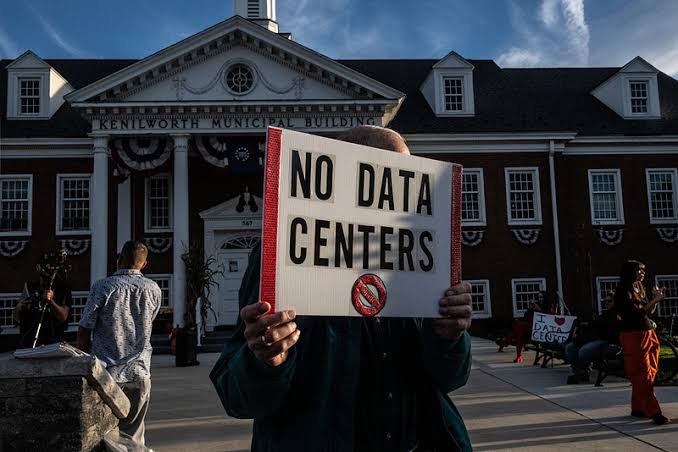
For years, the expansion of artificial intelligence has been presented as an economic and technological race that the United States cannot afford to lose. Technology companies have committed enormous sums to building the computing infrastructure needed to train and operate increasingly powerful AI systems. Governments have welcomed these investments, promising jobs, economic growth and a stronger American position in the global technology competition.
But the enthusiasm surrounding the AI boom is encountering resistance in an increasingly important place: the communities where its infrastructure is supposed to be built.
On November 3, 2026, American voters delivered a striking message through local elections and ballot initiatives. Across the country, communities overwhelmingly supported measures to restrict, delay or prevent the construction of new data centers. What had largely been treated as a technical planning issue has become a significant political dispute over electricity prices, water resources, environmental protection and the influence of major technology companies.
According to Stateline, 33 measures restricting data center development had either passed or were leading in vote counts late on election night, with additional results still pending. Subsequent reporting by Ballotpedia showed that 46 of 47 decided measures had produced outcomes favoring greater restrictions on data center development.
The results represent a substantial setback for an industry accustomed to presenting its infrastructure expansion as an almost unquestionable public good.
The Infrastructure Behind the AI Revolution
Data centers are the physical foundation of the modern digital economy. They house thousands of computer servers, networking equipment and storage systems that support everything from cloud computing and online banking to artificial intelligence.
The rapid development of generative AI has dramatically increased demand for this infrastructure. Training large AI models and responding to millions of user requests require enormous computing capacity, making access to data centers increasingly important for companies competing in the technology sector.
Microsoft, Google, Amazon and Meta are among the major companies investing heavily in expanding their computing infrastructure. Their investments reflect a broader expectation that artificial intelligence will become an integral part of economic activity, from manufacturing and healthcare to finance, education and national security.
However, the infrastructure required to sustain this transformation comes with substantial physical demands.
Unlike many traditional commercial developments, large data centers can require enormous quantities of electricity around the clock. Their cooling systems may also consume significant amounts of water, depending on their design and location. Their construction can require large areas of land, new power transmission infrastructure and additional industrial development.
The scale of these requirements is changing how communities perceive the facilities. What technology companies describe as essential infrastructure increasingly looks to some residents like an industrial project whose costs may extend far beyond the property on which it is constructed.
Why Communities Are Saying No
The resistance is not driven by a single concern. It reflects a combination of economic, environmental and political grievances.
Electricity prices have become one of the most important points of contention. Data centers require reliable power supplies, and the arrival of large facilities can create substantial new demand on electricity networks.
The central concern for residents is whether the infrastructure needed to serve these companies will ultimately increase costs for ordinary households. If utilities must build new power plants, transmission lines or other infrastructure to accommodate industrial demand, questions arise about how those investments will be financed and who will bear the expense.
Technology companies and utilities argue that large developments can help finance new infrastructure and stimulate economic activity. But residents want assurances that households will not subsidize electricity consumption for some of the world's wealthiest corporations.
Water consumption is another source of opposition. Depending on the cooling technology used, large data centers can require substantial water resources. In regions already experiencing water shortages or competing demands from agriculture and households, the prospect of allocating additional supplies to industrial facilities can generate considerable resistance.
There are also concerns about noise from cooling equipment, backup generators, construction activity and the conversion of agricultural land into industrial developments.
These concerns are particularly significant in smaller communities, where a single large development can transform the character of an area.
For residents, the question is not necessarily whether artificial intelligence has economic value. It is whether the benefits promised by developers justify the local costs and whether communities have sufficient power to negotiate the terms.
A Political Rebellion Against Big Tech
The November elections demonstrated that opposition to data centers is no longer confined to environmental organizations or a small group of local activists.
The issue has attracted support across traditional political divisions. Residents in Republican-leaning rural communities and Democratic urban areas have expressed similar concerns about electricity costs, water consumption, transparency and the growing influence of technology companies.
Ohio emerged as one of the most significant battlegrounds, with 21 local data center-related ballot initiatives. Communities across the state voted on proposals ranging from outright restrictions to zoning changes and development agreements.
In other states, including Illinois, Maine, California, Kansas and New Jersey, voters also supported measures limiting the expansion of data center infrastructure.
The results are politically significant because they demonstrate how a national debate over artificial intelligence can become a local electoral issue.
For technology companies, access to land, electricity and capital is not sufficient if local governments and residents are unwilling to accept new developments.
The political implications could extend beyond municipal elections. Candidates seeking public office may increasingly be expected to explain their positions on data center construction, electricity pricing, environmental safeguards and tax incentives offered to technology companies.
The issue also creates an unusual political divide. Governments may want to attract technology investment and maintain their country's competitive position in artificial intelligence, while the communities they represent demand greater protection from the consequences of that investment.
Who Actually Benefits From the AI Infrastructure Boom?
At the center of the dispute is a fundamental economic question: how should the benefits and costs of technological progress be distributed?
Technology companies argue that data centers generate investment, support employment, expand the tax base and provide infrastructure necessary for future economic growth.
These arguments are not without merit. Data center construction involves significant investment, and the facilities support a wider ecosystem of engineers, construction workers, equipment manufacturers, energy providers and technology businesses.
However, the employment argument is more complicated than it initially appears.
Building a large data center can generate considerable temporary construction employment, but once operational, many facilities require relatively small permanent workforces compared with traditional industrial plants of similar investment value.
This creates a potential imbalance. A community may surrender significant amounts of land, allocate substantial electricity capacity and accept environmental and infrastructure pressures without receiving employment opportunities proportional to the scale of the investment.
Tax incentives add another layer of controversy. Local governments sometimes compete to attract major developments by offering favorable tax arrangements, infrastructure support or other financial incentives.
If the public assumes part of the financial burden while most of the economic gains accrue to private companies and their shareholders, the political justification for these projects becomes increasingly difficult.
The debate is therefore about more than technology. It concerns the distribution of economic power in an economy increasingly shaped by a small number of exceptionally wealthy corporations.
The Cost of Rejecting Data Centers
Yet opposition to data centers also carries potential economic consequences.
Artificial intelligence is becoming an important component of economic competitiveness. The United States is competing with China and other countries to develop advanced computing infrastructure, improve AI capabilities and maintain technological leadership.
Restricting data center construction could slow the expansion of computing capacity, complicate investment decisions and encourage developers to relocate projects to jurisdictions with more accommodating policies.
There is also a danger that local restrictions could prevent communities from benefiting from investments that might otherwise provide meaningful tax revenue and economic opportunities.
Furthermore, data centers are not exclusively used for artificial intelligence. They support essential digital services, including financial systems, communications, cloud infrastructure and government operations.
A blanket rejection of data center development would therefore be an unnecessarily broad response to legitimate concerns about particular projects.
The challenge is to distinguish between opposing poorly planned developments and rejecting the infrastructure required to sustain a modern economy.
Communities do not necessarily need to choose between accepting every proposal and banning all future construction. Stronger environmental standards, transparent development agreements, independent assessments and protections against transferring infrastructure costs to households could provide a more sustainable approach.
America's AI Ambitions Face a Democratic Test
The election results reveal a growing contradiction in America's technology strategy.
Washington and Silicon Valley increasingly view artificial intelligence as a national priority. The ability to build advanced computing infrastructure is considered essential to economic competitiveness, technological innovation and national security.
But the political system through which these ambitions must be implemented remains accountable to local communities.
A federal government can encourage investment, technology companies can commit billions of dollars and financial markets can reward expectations of future AI growth. None of these developments automatically guarantees that residents will accept a data center in their neighborhood.
That is the lesson emerging from the November elections.
The AI industry has spent years competing over chips, computing capacity, energy contracts and investment capital. It must now confront another resource that cannot simply be purchased: public consent.
The companies that succeed in the next phase of the AI race may not necessarily be those that build the largest facilities or spend the most money. They may be those that demonstrate how their infrastructure can coexist with the economic and environmental interests of the communities around them.
Artificial intelligence may be transforming the global economy, but its physical infrastructure still has to occupy real land, consume real resources and operate within democratic societies.
America's data center backlash is not necessarily a rejection of technological progress. It is a demand that the costs of progress should not be imposed on communities without their consent.