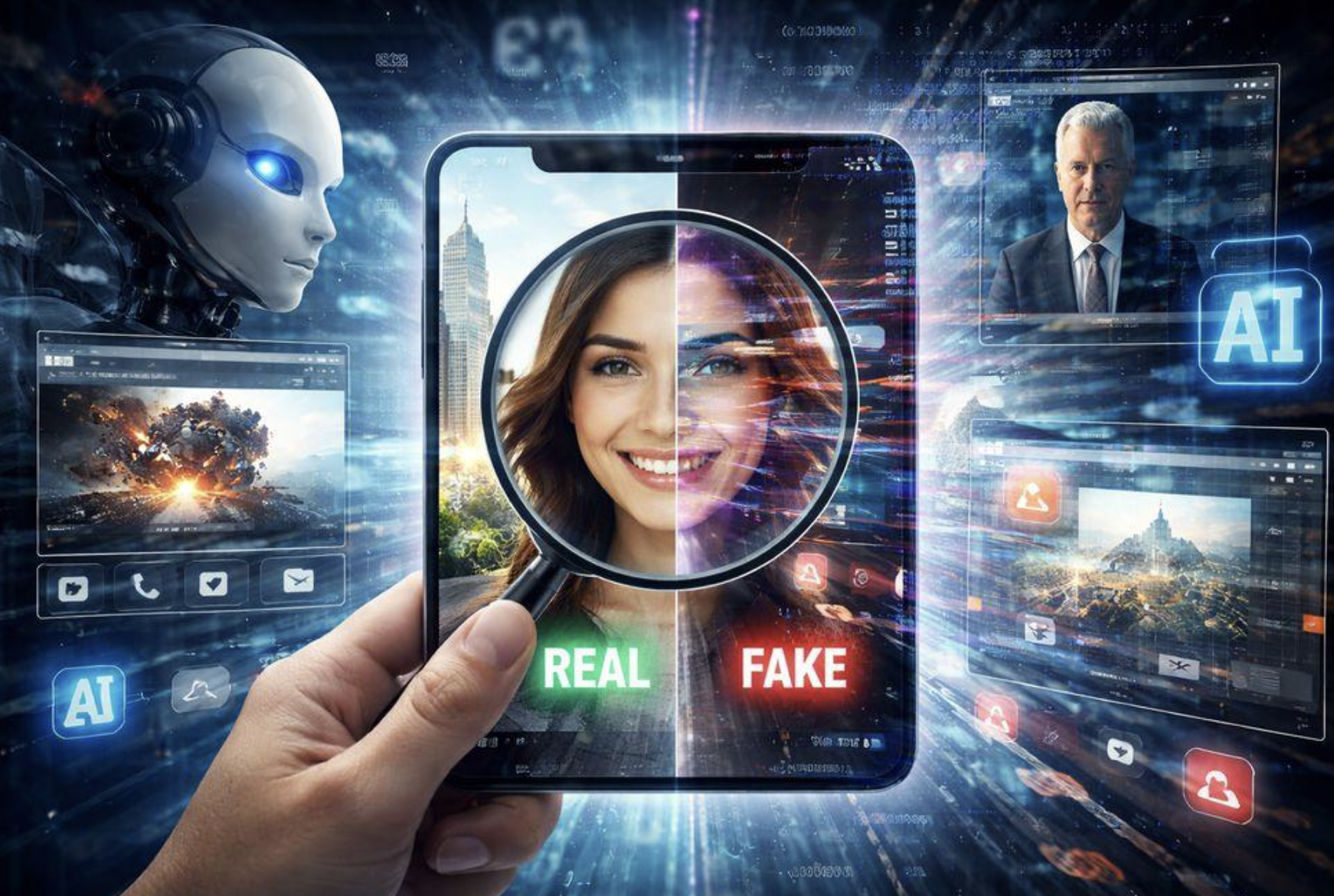
For much of the internet's history, misinformation depended on human effort. Someone had to write a misleading story, manipulate a photograph, imitate another person's voice or edit footage to distort an event. These activities were possible long before artificial intelligence, but they required time, technical ability and, in many cases, access to specialist tools.
Generative AI has fundamentally changed that equation.
Today, a person with limited technical knowledge can produce realistic images, synthetic voices, convincing videos and thousands of variations of a misleading narrative. The technology can imitate the appearance of news reports, reproduce the voices of public figures and generate written explanations that sound authoritative. What once required a coordinated production effort can increasingly be accomplished with accessible software.
This is not simply a new chapter in the history of fake news. It is a transformation in the economics of information, one that threatens to weaken the relationship between evidence and public trust.
The central problem is becoming increasingly difficult to resolve: when almost anything can be manufactured, how does society establish what is real?
AI Has Industrialised the Production of Misinformation
Misinformation is not new. Governments have used propaganda for centuries, political movements have manipulated public opinion, and fabricated stories have circulated through newspapers, radio and television. The internet made distribution faster and cheaper. Generative AI has now made production faster and cheaper too.
The distinction matters.
A misleading photograph once required someone to alter an existing image. A fabricated video required editing skills, visual effects or specialised production. A convincing impersonation of someone's voice required access to recordings and technical expertise. AI systems increasingly automate these processes.
The result is a dramatic reduction in the resources needed to manufacture persuasive content. A small group, or even an individual, can create material that appears to come from a politician, journalist, company executive or public institution.
The International Panel on the Information Environment's 2026 meta-analysis examined 60 experimental findings from 24 publications involving 33,801 participants. It found that more recent research has identified growing persuasive risks from AI-generated text, while public skepticism towards synthetic visual material has increased. The report also emphasised that the effects vary considerably across contexts.
This finding challenges the assumption that deepfake videos are necessarily the greatest threat. A fabricated video may attract attention, but a carefully written false explanation, repeated across websites and social platforms, can influence how people interpret an event long after the original claim has disappeared.
AI does not need to make every piece of misinformation convincing. It needs to make the production and distribution of misleading narratives sufficiently inexpensive that they can be generated, tested and repeated at scale.
The Deepfake Problem Is Becoming a Problem of Trust
Deepfakes have become the most recognisable symbol of AI-driven misinformation. Their potential impact is particularly serious because people have traditionally treated visual and audio evidence as powerful indicators of authenticity.
A video showing a political leader making an inflammatory statement, for example, can create an immediate public reaction. A fabricated recording of a company executive announcing financial trouble could affect investor confidence. A cloned voice impersonating a family member could be used in a fraud attempt.
The threat extends beyond the immediate deception. Even when a deepfake is exposed, the damage may not disappear.
A person who encounters a fabricated recording may remember the allegation even after learning that it was false. Others may never see the correction. And when authentic footage is challenged as AI-generated, the same technology can become a convenient excuse for avoiding accountability.
This creates a particularly dangerous situation: fabricated evidence can be presented as genuine, while genuine evidence can be dismissed as fabricated.
The result is not simply a world in which people believe more falsehoods. It is a world in which people become less certain that evidence can establish the truth at all.
AI Is Creating a New Challenge for Elections and Political Communication
Political information is especially vulnerable because elections and public controversies often unfold under intense pressure. Voters make judgments before every fact is established, political campaigns compete to shape public perception, and misleading claims can spread faster than official responses.
The 2026 US midterm campaign has provided a recent illustration of the challenge. In an August 2026 study, the Brennan Center for Justice tested six widely used AI products to assess their responses to election conspiracy theories and their ability to generate deceptive election-related media.
The researchers found an important contradiction. The chatbots generally challenged the conspiracy theories presented to them, but the researchers were also able to generate misleading election-related images and videos using popular AI tools. The systems also performed poorly when asked to identify some of the synthetic material they had helped create.
A follow-up analysis published in October reported that, among six image-generation systems tested again, only one company had significantly improved its safeguards against creating deceptive election imagery.
These findings expose a structural weakness in the current AI ecosystem. The same technology can help people investigate misinformation while also making the production of misinformation easier.
The danger is not confined to whether a fabricated video changes the result of an election. It also concerns the credibility of the electoral process itself. False claims about ballot counting, election officials or political candidates can deepen suspicion, particularly when institutions already face declining public trust.
AI-generated political content is therefore not merely a content moderation problem. It is a challenge to the institutions that depend on shared evidence and public confidence.
The Information War Is Moving Beyond Images and Videos
The public conversation about AI misinformation often focuses on spectacular deepfakes. Yet the more consequential transformation may be less visible.
Generative AI can produce articles, social media posts, comments, fabricated expert explanations and apparently independent accounts of the same event. These materials can be adapted for different audiences, languages and political environments.
A false claim about a conflict, for example, can be repackaged as a news summary, a personal testimony, a supposedly leaked document or an explanation written in the style of an analyst. Each version can make the same underlying narrative appear to have multiple sources.
This is particularly concerning during wars, financial crises, public health emergencies and political transitions, when reliable information is often incomplete and people are searching for explanations.
The International Panel on the Information Environment's research suggests that text-based AI misinformation deserves greater attention than it often receives. Its findings indicate that more recent studies have reported higher perceived credibility of AI-generated textual misinformation, while the effectiveness of simple content labels varies considerably.
The implication is significant: the next information crisis may not be defined by one extraordinary fake video. It may emerge from thousands of ordinary-looking pieces of content that collectively distort public understanding.
The Detection Arms Race Has a Fundamental Weakness
Technology companies are developing systems to identify synthetic content, but detection is becoming an increasingly difficult contest.
AI-generated material changes as generative models improve. Detection systems trained to recognise the characteristics of one generation of synthetic images may become less effective against newer systems. Content can also be compressed, edited, cropped or redistributed in ways that remove information useful for verification.
This creates an arms race in which detection methods must continually adapt to increasingly capable generation tools.
There is also a deeper limitation: detecting whether something was generated by AI is not the same as determining whether it is true.
An authentic photograph can be used with a false caption. A genuine video can be edited to remove essential context. A human-written article can contain fabricated information. Conversely, an AI-generated illustration or reconstruction can be clearly labelled and used responsibly.
The important question is not simply whether AI was involved in producing content. It is whether the content accurately represents what it claims to show.
That distinction makes verification more complicated than building a detector that classifies images as real or artificial.
Can Technology Restore Trust?
The technology industry is beginning to develop a different approach: rather than relying exclusively on detecting synthetic content, systems can attach information about where content originated and how it was created or edited.
One important initiative is the Coalition for Content Provenance and Authenticity (C2PA), which develops technical standards for attaching verifiable information to digital media. These credentials can help establish a record of a file's origin and subsequent handling.
Companies are also developing watermarking and verification systems. In May 2026, OpenAI outlined an approach combining C2PA credentials, Google's SynthID watermarking technology and public verification tools. Its July update expanded supported watermarking and verification capabilities to certain AI-generated audio.
These developments represent a meaningful step towards a more transparent digital environment. Instead of asking only whether a detector believes an image is fake, users and platforms can increasingly examine whether reliable information about its origin is available.
However, provenance systems have limitations. Metadata can be removed, watermarks may not survive every transformation, and verification tools may only recognise content produced by particular systems. OpenAI itself acknowledges that the absence of a detectable signal does not prove that an image is authentic.
No single technical solution can establish truth across the entire internet.
A credible response will require several layers: transparent AI-generation practices, stronger safeguards against deceptive use, independent journalism, effective platform policies, accessible verification tools and public education.
The Global Consequences Will Not Be Distributed Equally
The ability to manufacture convincing information is becoming more widely available, but societies do not have equal resources to respond.
Countries with established independent media, digital verification organisations and well-funded institutions may have greater capacity to investigate suspicious content. Other societies may face greater difficulties, particularly where journalism is under pressure, public institutions are mistrusted or access to reliable information is limited.
Language is another important challenge. Verification systems and AI safety measures do not necessarily perform equally across languages and cultural contexts. Content circulating in less-resourced languages may receive less attention from technology companies, researchers and fact-checking organisations.
For Africa, this is particularly relevant. Political information often circulates through a combination of social media, messaging platforms, radio and local networks. A fabricated recording or misleading image can travel through private groups before journalists or independent fact-checkers have an opportunity to examine it.
The problem is not that African audiences are uniquely vulnerable to misinformation. It is that the resources available to verify information, challenge powerful actors and correct false narratives are unevenly distributed.
As AI becomes more accessible, investment in independent journalism, local-language verification and digital literacy will become increasingly important. The ability to generate information is expanding rapidly. The ability to establish its credibility must expand too.
The Future of AI Depends on More Than Its Ability to Generate
Artificial intelligence is not inherently a misinformation machine. The same technologies that can create fabricated evidence can help journalists analyse large collections of documents, translate information, identify manipulated media and investigate suspicious claims.
The Brennan Center's 2026 research illustrates this duality. Its tests found that chatbots could challenge several established election conspiracy theories even as the same broader ecosystem made deceptive media easier to produce.
The challenge, therefore, is not to stop the development of generative AI. It is to build an environment in which the technology's creative and analytical capabilities do not come at the expense of public trust.
That requires technology companies to treat authenticity and provenance as core infrastructure rather than optional features. It requires platforms to respond more effectively to coordinated deception. It also requires governments to develop proportionate rules that address harmful manipulation without turning the fight against misinformation into a justification for suppressing legitimate speech.
Ultimately, the age of manufactured reality will not be defined only by how realistic AI-generated content becomes. It will be defined by whether societies can preserve reliable ways of distinguishing evidence from fabrication.
For centuries, people have relied on photographs, recordings, documents and eyewitness accounts to understand events beyond their immediate experience. Those forms of evidence have never been infallible, but their credibility has been central to journalism, law, science and democratic debate.
AI is putting that relationship under pressure.
The most serious consequence may not be that people begin believing everything they see. It may be that they eventually stop believing anything at all.
In that environment, the most valuable technology of the AI era may not be the one that creates the most convincing image or video. It may be the one that helps establish where information came from, whether it has been altered and whether its claims can be independently verified.