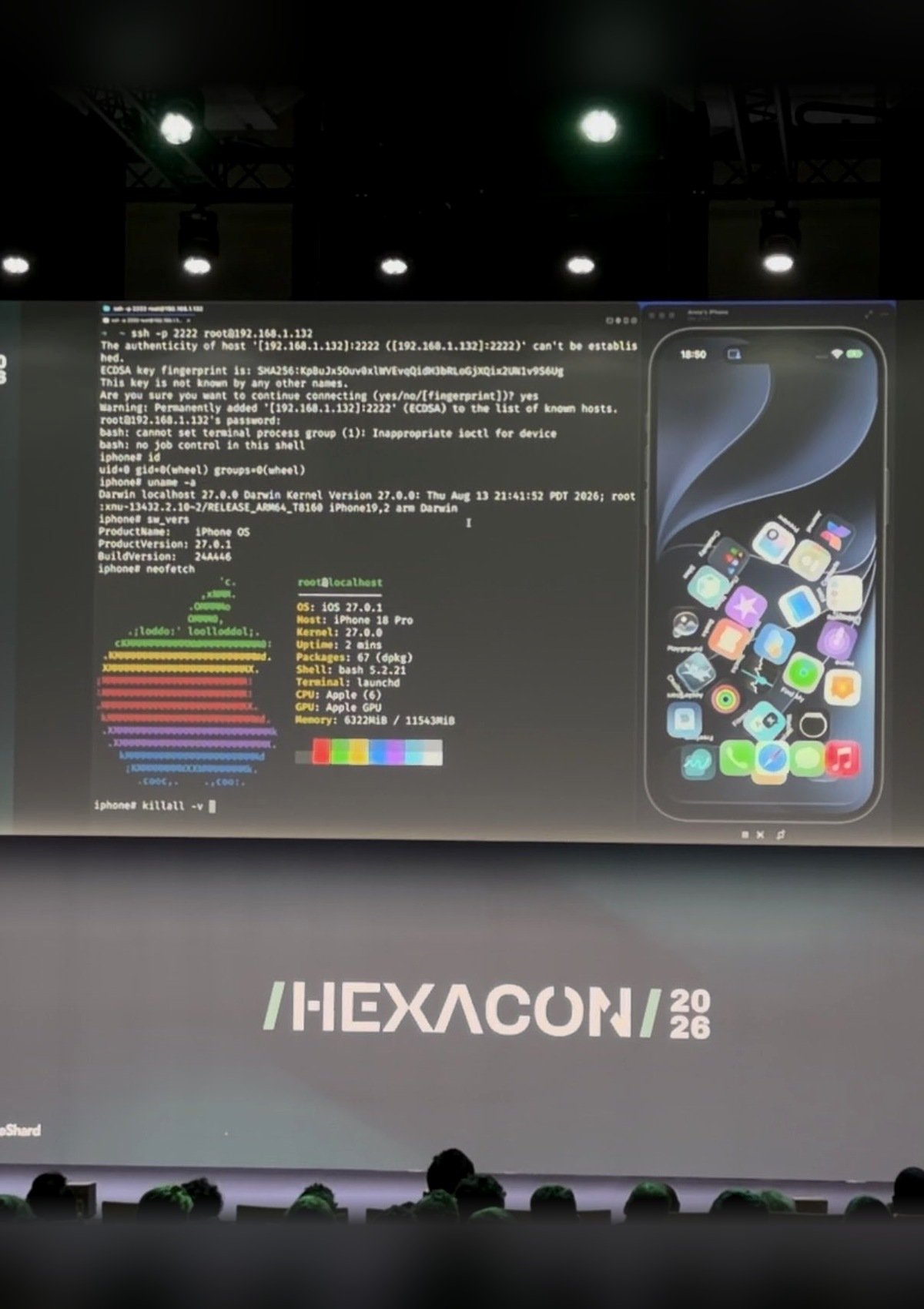
NEW YORK — On October 16, 2026, a security research team named Calif publicly demonstrated an untethered jailbreak on an iPhone 18 Pro running iOS 27.0.1, Apple's latest public operating system. The demonstration, which took place at the Hexacon offensive security conference in Paris, showcased persistent root-level access on the cutting-edge device, a feat that highlights the ongoing challenges in mobile security.
According to a reconstruction by Cyber Security News, the Calif team presented an iPhone 18 Pro (internal codename iPhone19,2, with a T8160 chip and iOS 27.0.1 build 24A446, on Darwin kernel 27.0.0) that was rebooted. After the device restarted, it automatically restored root access without needing any connection to a computer. The researchers then unlocked the phone using its regular passcode and proceeded to demonstrate an open SSH session as the root user, confirming persistent, high-level control over the device.
Root access, analogous to "administrator privileges" on other operating systems, signifies the highest level of control over a device. On an iPhone, this means bypassing Apple's software restrictions, granting the user or an attacker complete command over the operating system. Such access enables fundamental modifications to the device's core functions, including patching the kernel to allow full file system access. With root privileges, one could install unauthorized software, deeply customize the OS, alter system configurations, access sensitive user data, or even disable built-in security features. In a malicious context, this level of access could facilitate the installation of persistent malware, complete system compromise, and data exfiltration.
The "untethered" nature of this jailbreak is a critical technical distinction. It means the device remains jailbroken even after a full reboot, without requiring reconnection to a computer or any user interaction to re-enable the jailbreak. This contrasts sharply with other jailbreak types: tethered jailbreaks, which demand a computer connection and specific software for every restart; semi-tethered, allowing independent non-jailbroken boots but still needing a computer to re-enable the jailbreak; and semi-untethered, where the jailbreak can be re-enabled from an on-device app. The persistence of Calif's exploit after a reboot suggests the vulnerabilities are deeply embedded, likely residing in critical, early boot stages or within the operating system's core, allowing modifications to survive system integrity checks during startup. This level of persistence is exceptionally rare on modern iOS devices.
Modern iPhones are notoriously difficult to jailbreak, particularly current-generation hardware and iOS versions. Apple has significantly hardened the iOS kernel and bootloader over recent releases, making stable public jailbreaks far less common than in earlier eras. Key security features that pose substantial challenges for exploit developers include Signed System Volume (SSV), introduced in iOS 14, which cryptographically seals the system partition to prevent unauthorized modifications; Kernel Patch Protection (KPP), which actively monitors the kernel for alterations; and Pointer Authentication Codes (PAC), present in A12 chips and newer, using hardware-backed cryptographic signatures to protect against memory corruption. The Secure Enclave, a dedicated secure subsystem, further isolates critical security functions. Overcoming these layers requires chaining multiple sophisticated zero-day vulnerabilities.
As of October 16, 2026, the Calif security team has not publicly disclosed the specific vulnerabilities or the exploit chain used. This non-disclosure is a common practice among researchers, who may opt to keep details private for responsible disclosure to Apple, sale to private firms, or to maintain a competitive edge. While specific details are scarce, recent reporting on Apple security vulnerabilities in 2026 provides context. For instance, Apple patched CVE-2026-20617, a race condition allowing root privileges, and CVE-2026-20626, a local privilege escalation flaw, both in February 2026. Additional privilege escalation vulnerabilities were addressed in March 2026, affecting iOS versions prior to 26.4. These examples illustrate the ongoing discovery of flaws that can be leveraged for root access, though they are not directly linked to Calif's current exploit. It is also notable that Pwn2Own Ireland 2026, a major hacking competition held earlier in October, offered a significant bounty for a remote compromise of the iPhone 17, yet no teams registered to attempt it, underscoring the difficulty of such tasks on even slightly older models.
Apple's ability to patch the vulnerabilities demonstrated by Calif hinges entirely on the nature of the underlying flaws. If the exploit chain relies solely on software bugs within iOS 27.0.1, Apple can almost certainly address it through a software update. This is the most frequent scenario for iOS vulnerabilities, with Apple regularly releasing security updates to resolve such issues. The timeline for a fix can vary, but Apple typically prioritizes critical security flaws. However, if the exploit leverages a vulnerability in the device's BootROM, the immutable code that runs at startup, the situation becomes far more complex. BootROM exploits are embedded in hardware and cannot be patched via software updates. The checkm8 BootROM exploit, affecting iPhones from the 5s to the X, serves as a historical example of an unpatchable hardware vulnerability on specific generations. For a newer device like the iPhone 18 Pro, a BootROM exploit would be a monumental discovery, given Apple's continuous efforts to harden its hardware. Without disclosure of technical details, it remains unconfirmed whether Calif's demonstration utilized a software or hardware vulnerability, though the "untethered" nature implies a low-level, persistent flaw.
Apple's standard response to publicly demonstrated security vulnerabilities involves a thorough investigation. The company typically maintains a policy of not disclosing, discussing, or confirming security issues until an investigation is complete and patches or releases are available to protect customers. Once the vulnerabilities are understood and a fix is developed, Apple will likely release an iOS update to address the issues. This process can take time, potentially weeks to several months, depending on the complexity of the vulnerabilities and the scope of necessary changes. Apple's security team is known for its rapid response to critical flaws, but a precise timeline cannot be known without understanding the specific vulnerabilities involved.
While the demonstration of an untethered jailbreak on a recent iPhone is a significant security research achievement, it does not automatically mean that ordinary iPhone users currently face a meaningful security risk. The vulnerabilities used by Calif have not been publicly disclosed, meaning the technical details required to replicate the exploit are not available to malicious actors. Furthermore, modern jailbreaks, particularly untethered ones, are highly complex and require sophisticated exploit chains; they are not simple "one-click" solutions for the average user or less skilled attackers. Exploits demonstrated at security conferences are often proof-of-concept, primarily used to highlight weaknesses and drive improvements, rather than being immediately weaponized for widespread attacks. The reporting does not specify if physical access, an unlocked device, passcode knowledge, or prior preparation was required for Calif's demonstration, though sophisticated exploits often require some level of initial access or interaction. Local privilege escalation vulnerabilities, such as those patched earlier in 2026, typically require a malicious application to be installed and executed on the target device. Therefore, while the existence of such an exploit is a concern for Apple, it is unlikely to pose an immediate, widespread threat to the general user base. Users should continue to keep their devices updated to the latest iOS versions to receive Apple's security patches.
The successful demonstration of untethered root access on a cutting-edge device like the iPhone 18 Pro running iOS 27.0.1 underscores the persistent "cat-and-mouse" dynamic between Apple's security engineers and the global security research community. It highlights that despite Apple's continuous efforts to harden iOS and its hardware, vulnerabilities can still be discovered and exploited. This achievement represents an important security-research milestone, exposing potential weaknesses in Apple’s security architecture that the company will undoubtedly work to address. Historically, major iPhone jailbreaks, such as those from the "JailbreakMe" era or the checkm8 BootROM exploit, have often led to significant advancements in iOS security as Apple responds by implementing new defenses. Modern jailbreaks have become considerably more difficult due to the sophisticated security layers implemented by Apple, making any successful demonstration on current-generation hardware a notable event. This latest exploit will likely prompt Apple to conduct an in-depth review of its security mechanisms, potentially leading to further enhancements in future iOS versions and hardware designs. However, it does not automatically imply that ordinary iPhones can now be easily compromised, but rather serves as a critical data point for the evolution of mobile security.