North Korea’s cyber operations are entering a more dangerous phase. A state-backed hacking network accused of stealing $6.3 billion from cryptocurrency exchange Binance is benefiting from artificial intelligence tools that can accelerate target research, improve social engineering and reduce the technical expertise required to prepare sophisticated attacks.
The development highlights a growing problem for the cryptocurrency industry: attackers no longer need to compromise thousands of individual investors to steal enormous sums. They can focus on a small number of companies holding billions of dollars in digital assets, study how those businesses operate and look for weaknesses in the systems that control their money.
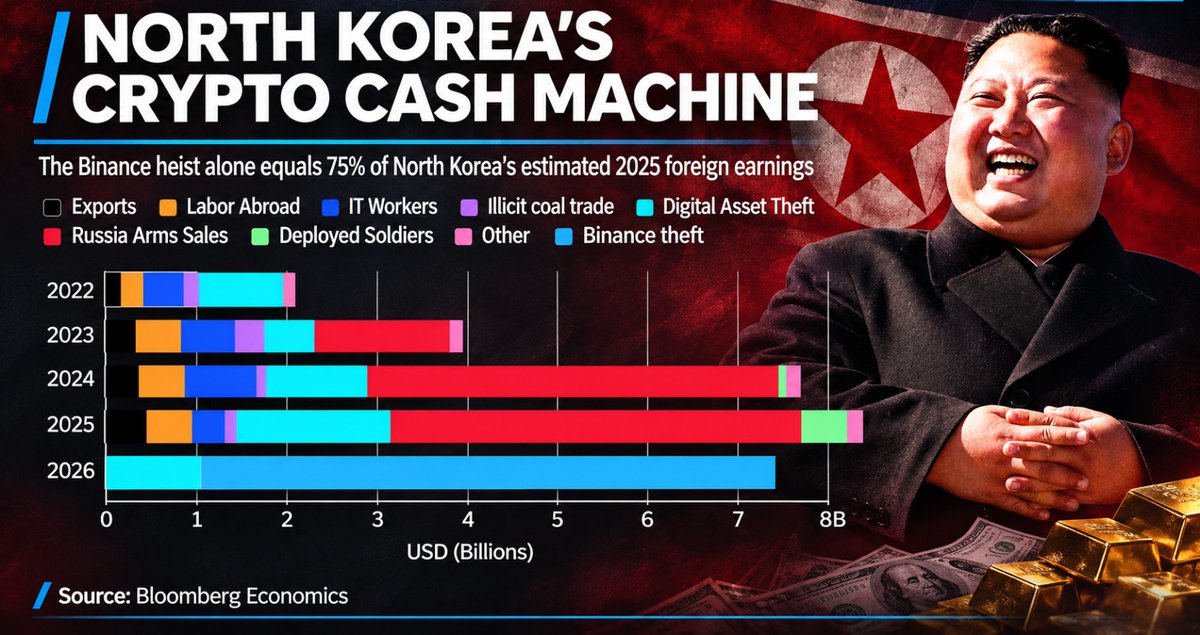
The scale of the latest Binance incident illustrates the stakes. On October 29, 2026, attackers stole approximately $6.3 billion in cryptocurrency from wallets associated with the exchange. Most of the funds were moved in roughly 20 minutes, according to blockchain investigators. On October 31, the US Federal Bureau of Investigation (FBI) officially attributed the theft to North Korea, identifying the malicious activity as TraderTraitor.
The incident has renewed attention on how Pyongyang is combining cybercrime, intelligence operations and emerging technologies to generate revenue for a heavily sanctioned state.
The Binance hack: Billions stolen in 20 minutes
The Binance incident is one of the largest cryptocurrency thefts ever reported. According to blockchain intelligence firms, the attackers moved funds from wallets across multiple blockchain networks, transferring the assets into addresses under their control.
The speed of the operation was striking. Although the preparation took considerably longer, the main theft unfolded in approximately 20 minutes. That distinction matters: a sophisticated cyberattack is rarely a matter of simply breaking into a system and immediately taking the money. It can involve reconnaissance, testing, access to internal systems and carefully timed execution.
Blockchain investigators reported that the attackers had prepared code and tested transactions before carrying out the operation. Binance initially suspected that a compromised engineer's laptop may have played a role, although its subsequent investigation identified additional points of breach. The company also reported that the attackers used a mechanism designed to destroy evidence.
The FBI's October 31 announcement confirmed that North Korea was responsible for stealing more than $6 billion in virtual assets from Binance. It said the attackers were converting the stolen cryptocurrency primarily into Ethereum, with further laundering expected through decentralized finance platforms and instant cryptocurrency swap services.
The amount stolen should not be confused with the amount the attackers ultimately keep. Binance said it had set aside more than $6.34 billion to cover the losses, while the company and industry partners worked to freeze or recover stolen assets. Reuters reported that approximately $3 billion in affected assets had been located.
The incident demonstrates how quickly a cryptocurrency security breach can become an international financial and law-enforcement operation.
TraderTraitor: North Korea's big-game hunters
The FBI identifies the Binance operation as TraderTraitor, a name associated with North Korean state-sponsored cyber activity. Cybersecurity researchers had already linked the attack to the group before the FBI's formal announcement.
TraderTraitor is notable for its focus on high-value targets. Rather than concentrating primarily on individual cryptocurrency holders, the operation targets major exchanges, financial technology businesses and other organizations with access to substantial digital assets.
Security specialists describe this approach as big-game hunting. The objective is to compromise a company or its critical infrastructure and obtain access to a much larger pool of funds than would be available from individual victims.
The group is believed by some experts to have only around a dozen highly skilled members, despite operating within North Korea's much larger cyber workforce. That estimate illustrates an important feature of modern cyber operations: a relatively small team can cause enormous financial damage when it combines specialist expertise, careful preparation and access to valuable targets.
TraderTraitor was also linked to the February 2025 Bybit hack, in which approximately $1.5 billion in cryptocurrency was stolen. The FBI previously attributed that theft to North Korean hackers.
The two incidents reveal a consistent strategy. Rather than relying on large numbers of low-value attacks, North Korean operators have demonstrated an ability to pursue major cryptocurrency businesses and exploit weaknesses that can expose enormous amounts of money.
How artificial intelligence is changing the threat
Artificial intelligence is not necessarily giving hackers entirely new capabilities. Its more immediate advantage is making existing techniques faster, cheaper and easier to scale.
Researching a large financial technology company can require considerable time. Attackers need to understand its business model, identify employees with privileged access, study its software infrastructure and determine how transactions are approved. AI tools can help accelerate several of these activities by processing large amounts of publicly available information, explaining unfamiliar technical systems and assisting with the preparation of convincing communications.
Cybersecurity experts cited in Bloomberg's November 2 reporting say North Korean hackers are using AI to improve their ability to identify and study potential targets. The tools can help operators understand complex systems and reduce the time needed to develop the knowledge required for an attack.
Microsoft's October 29 threat-intelligence research provides further evidence of this broader trend. It documented North Korean threat actors using generative AI across different stages of cyber operations, including reconnaissance, social engineering, maintaining fraudulent identities, supporting tool development and automating repetitive tasks.
Google's threat-intelligence team has also documented North Korean actors using AI to research cryptocurrency-related subjects and prepare material for social-engineering campaigns.
However, there is an important distinction between evidence of AI adoption by North Korean hackers and proof that AI was responsible for a particular theft. The FBI's Binance announcement did not say that artificial intelligence was used to execute the attack. The evidence supports a broader conclusion: North Korean cyber operators are incorporating AI into their activities, but the precise role of AI in the Binance breach has not been publicly established.
That distinction matters because exaggerated claims about autonomous AI hackers can distract from the more immediate danger. Human operators are still directing these campaigns, while AI makes their work more efficient.
The human weakness: Employees are still the target
Despite the growing sophistication of their technical operations, North Korean hackers frequently exploit a much older vulnerability: human trust.
One recurring technique involves approaching employees through professional networking platforms, messaging services and seemingly legitimate recruitment opportunities. Attackers may pose as recruiters, business contacts or representatives of technology companies, offering attractive jobs or lucrative contracts.
The objective is to establish contact with people who have access to sensitive corporate systems. A developer, engineer or IT administrator can become a valuable entry point if persuaded to open a malicious file, install compromised software, reveal credentials or participate in a fake technical interview.
AI makes these approaches more effective by helping attackers research individuals and organizations, prepare tailored messages and overcome language barriers. It can also make fraudulent professional identities and communications appear more convincing.
This is particularly concerning in cryptocurrency businesses, where a relatively small number of employees may have access to infrastructure that controls large amounts of digital assets.
A company can spend millions securing its blockchain infrastructure and still face serious exposure if an employee's computer or credentials become compromised. In other words, the most expensive security system in the building may not protect it from a convincing fake job offer.
Why North Korea is stealing cryptocurrency
North Korea operates under extensive international sanctions that restrict its access to the global financial system. Its cyber operations provide an alternative means of generating foreign currency and financing state priorities.
Cryptocurrency is particularly attractive because digital assets can move across borders without relying on conventional banking networks. Although blockchain transactions are publicly recorded and can be investigated, stolen funds can be moved through multiple wallets, decentralized finance platforms and conversion services in attempts to make their origins harder to trace.
The financial scale is significant. According to Chainalysis, North Korean hackers stole at least $2.02 billion in cryptocurrency during 2025, a 51% increase from the previous year. That brought the estimated cumulative total attributed to North Korean actors to $6.75 billion by the end of 2025.
These figures predate the October 2026 Binance theft.
International monitoring bodies and US officials have repeatedly assessed that revenue from North Korean cybercrime helps finance the country's weapons programmes, including its nuclear and ballistic missile development. A 2025 multinational assessment estimated that cryptocurrency theft accounted for approximately one-third of North Korea's foreign-currency revenue in 2024. Other assessments have suggested that illicit cyber revenue could finance a substantial share of its weapons programmes.
The precise amount reaching the military is difficult to establish. Money stolen by hackers is not automatically transferred in full to a weapons programme, and laundering, conversion and recovery efforts can reduce the amount ultimately available to the regime. Nevertheless, the connection between cyber theft and North Korea's ability to evade sanctions is well documented.
For Pyongyang, cryptocurrency theft is not simply a financial crime. It is part of a wider strategy for obtaining resources despite international restrictions.
The challenge for cryptocurrency companies
The Binance incident raises difficult questions about the security of centralized cryptocurrency exchanges. These companies operate infrastructure that can hold or control billions of dollars in digital assets, making them attractive targets for state-backed hackers.
Traditional financial institutions have spent decades developing security controls, regulatory oversight and procedures for authorizing large transactions. Cryptocurrency businesses have developed their own safeguards, but the sector's rapid growth, complex technical infrastructure and interconnected services create a large attack surface.
Security cannot depend solely on protecting private keys or monitoring suspicious blockchain transactions. Companies also need to examine the people and systems that can access those keys, approve withdrawals, modify software and administer critical infrastructure.
That means stronger employee verification, tighter access controls, independent approval procedures for large transfers, continuous monitoring of privileged accounts and better protection of developers' devices. Recruitment processes also deserve attention, particularly when employees are approached by unfamiliar organizations offering unusually attractive opportunities.
AI introduces another layer of difficulty. Security teams can use the same technology to detect suspicious activity, analyze threats and automate defensive work, but attackers can also use it to improve reconnaissance and social engineering. The advantage will depend partly on which organizations adopt these tools effectively and integrate them into their security operations.
AI is making cybercrime more accessible, not autonomous
The most important lesson from North Korea's evolving cyber strategy is not that artificial intelligence has replaced skilled hackers. It is that AI can make a skilled hacker significantly more productive.
A relatively small group can investigate more targets, process technical information faster and prepare more convincing attempts to gain access. That creates a serious imbalance when the potential reward is billions of dollars and the cost of launching digital operations remains comparatively low.
The Binance theft also demonstrates why cryptocurrency security is increasingly a matter of national security. When state-backed hackers can steal assets on this scale, the consequences extend beyond exchange customers and investors. They can help finance governments seeking to bypass sanctions and sustain military programmes.
North Korea once relied on counterfeiting and other illicit financial activities to generate hard currency. Its cyber operations now provide a far more scalable way to target the global economy. AI is adding speed and efficiency to that strategy, even if human operators remain firmly in control.
The next major cryptocurrency breach may not depend on a revolutionary new hacking technique. It may come from a familiar combination of compromised employees, weak access controls and careful preparation, executed faster with the help of AI.