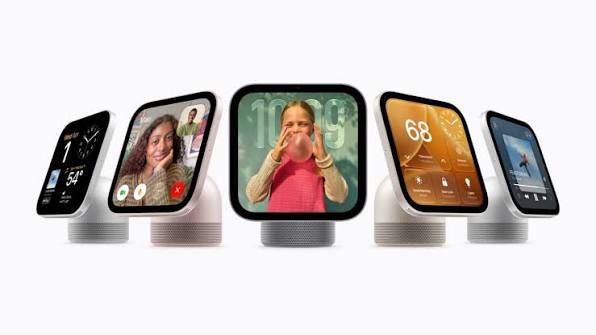
NEW YORK — Apple entered the smart display category on Tuesday, October 13, 2026, unveiling a dedicated household screen called HomeView at an event streamed from its headquarters under the banner Welcome Home. The device represents the company's most direct effort to claim a permanent visual presence on kitchen counters and hallway walls, an area long controlled by rival screens from Amazon and Google. Apple confirmed that customer pre-orders opened immediately following the event, with units scheduled to ship and arrive in retail stores on November 13, 2026.
Priced at $299 in the United States, HomeView will sell in two physical formats. A tabletop version comes equipped with a small pedestal base and ships in silver, starlight, rose pink, and space gray finishes. A separate wall-mounted configuration is limited to space gray and silver. Both versions center on a 7-inch Liquid Retina display powered by Apple's A18 processor, the same silicon family introduced in its recent mobile devices, paired with an array of environmental sensors capable of measuring indoor temperature, humidity, ambient lighting, and physical movement.
Hardware specifications disclosed during the announcement show that Apple built the device around communications and household media. A 12-megapixel Center Stage camera sits above the display to track subjects during FaceTime calls. Sound is delivered through two custom full-range audio drivers, with the tabletop unit incorporating an added woofer driven by computational audio tuning. The system runs an operating software layer described by company executives as drawing elements from the Apple Watch and CarPlay interfaces, allowing it to display compact interactive tiles and run select third-party software, including applications adapted from CarPlay standards.
Personalization stands as the device's primary operating mechanism. Apple stated that HomeView can store biometric facial profiles for up to six household members. As an individual approaches the screen, the front camera identifies the user and shifts the interface to show their specific Messages, Calendar itineraries, Reminders, FaceTime history, and Find My notifications. When no enrolled face is detected, the screen reverts to a shared ambient layout displaying family schedules, weather metrics, and home controls.
The launch arrives after more than a decade of uneven results for Apple's domestic hardware strategy. The company introduced its HomeKit developer framework in 2014, promising an encrypted, standardized approach to residential automation. Yet for years, strict hardware certification guidelines limited the selection of compatible accessories compared to the sprawling catalog supporting Amazon's Alexa. Apple later tried to establish household audio beachheads with the original HomePod speaker in 2018 and the smaller HomePod mini in 2020. While praised for audio engineering, the speakers met skepticism over their premium pricing and their reliance on Siri, an assistant that frequently fell behind Google Assistant and Alexa in conversational flexibility and multi-step execution. Prior to Tuesday's announcements, Apple's dedicated smart-home hardware catalog had gone without a major hardware revision for more than three years.
Apple has attempted to mitigate its historical walled-garden limits by embracing Matter, the cross-industry standard designed to make connected hardware work across competing ecosystems. HomeView acts as a direct controller and border router for both Matter and Thread wireless networking protocols, operating alongside traditional HomeKit and Works with Apple Home hardware. Alongside the display, Apple revealed the Apple Home Collection, a collaborative line of connected accessories developed with Schneider Electric and LG Electronics that includes thermostats, door locks, and indoor cameras. Apple confirmed that all accessories in the collection support Matter, with the single exception of LG's cameras, which rely on Apple's proprietary framework.
To address long-standing criticisms of its voice assistant, Apple is using HomeView to roll out what it calls Siri AI, powered by Apple Intelligence. The updated voice interface is designed to parse natural syntax, retain conversational context across back-to-back instructions, and read on-screen context to perform multi-stage domestic tasks, such as translating online recipe steps into distinct cooking timers. The system also pulls personal context from connected apps when responding to recognized residents.
Data security serves as Apple's central selling argument against its rivals. The A18 processor inside HomeView includes isolated hardware zones dubbed Secure Exclaves, which isolate raw video feeds and microphone input from apps, the central operating system, and Apple itself. Company materials emphasize that private data from communications apps will not appear on screen through facial recognition alone. The device also requires that the recognized user's paired iPhone or iPad has been unlocked recently and remains active on the same local Wi-Fi network. Queries handled away from the hardware rely on Private Cloud Compute, a cloud processing architecture that Apple maintains does not retain user logs or grant company staff access to personal records. For security feeds, the hub can display up to nine live camera streams at once, using HomeKit Secure Video to encrypt footage and identify people, pets, and package deliveries while listening locally for the audio frequencies of household smoke and carbon monoxide alarms.
The hurdles facing HomeView remain significant. Amazon and Google have spent nearly ten years entrenching their Echo Show and Nest Hub hardware in tens of millions of homes, frequently discounting entry-level displays below $100. Those platforms offer deep catalogs of third-party software actions, voice skills, and retail tie-ins that Apple has yet to duplicate. While Google manufactures its own Matter-ready Nest thermostats and Amazon continues to support an immense range of budget-friendly peripheral gear, Apple's $299 price tag places HomeView firmly in the premium tier of home electronics, well above mass-market alternatives.
Still, Apple holds an advantage in its base of high-income smartphone owners who already route their communication, media subscriptions, and family data through iOS. By combining identity-aware software, tight device security, and broad Matter interoperability, Apple is betting customers will pay a premium to avoid the advertising-driven interfaces common on rival displays.
The broader question for the company is whether HomeView will remain a luxury companion for iPhone owners or establish itself as the foundation for an entirely new computing category. Alongside refreshed iterations of the Apple TV 4K and HomePod mini 2 announced at the same event, the screen signals that Apple is no longer content to treat domestic hardware as a peripheral hobby. If consumers embrace a shared household terminal that recognizes their faces and organizes their private routines, HomeView could transition Apple's software platform from personal pockets onto the walls of the modern home.